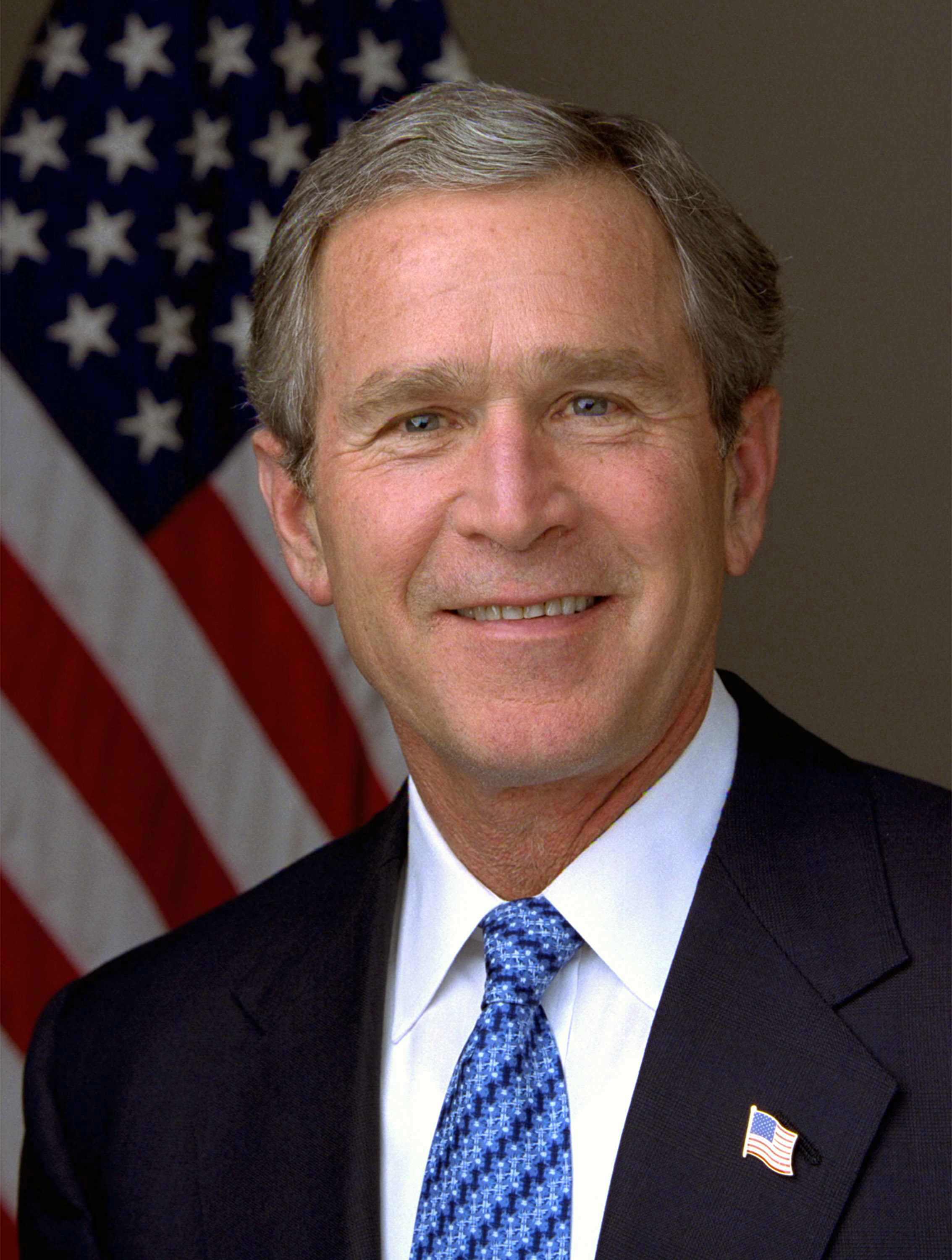
43rd President • 2001–2009
George W. Bush
George W. Bush entered the White House promising tax relief, education reform, and compassionate conservatism. The terrorist attacks of September 11, 2001, transformed his presidency. His response reshaped national security, launched two major wars, and intensified debate over presidential power. His administration also expanded international health assistance before ending amid a severe financial crisis.

At a Glance
Quick Facts
| Born | July 6, 1946, in New Haven, Connecticut |
|---|---|
| Presidency | January 20, 2001–January 20, 2009 |
| Political party | Republican |
| Vice president | Dick Cheney |
| First lady | Laura Bush |
| Predecessor | Bill Clinton |
| Successor | Barack Obama |
Why He Matters
A Presidency Transformed by September 11
Few modern presidents experienced such a dramatic change in national priorities. Bush began with a domestic agenda centered on schools, taxes, and community institutions. After September 11, preventing another terrorist attack became his administration’s central mission.


His presidency poses enduring questions: How should a republic respond to an extraordinary threat? What limits govern a president during wartime? And how should Americans weigh determined leadership against mistaken judgments and their consequences?
The Road to the Presidency
From Texas to the White House
The son of President George H. W. Bush, George W. Bush grew up primarily in Texas. He graduated from Yale, served as a pilot in the Texas Air National Guard, and earned an MBA from Harvard Business School.
Before becoming governor, he worked in the oil industry and became managing general partner of the Texas Rangers baseball team. He won the Texas governorship in 1994 and reelection in 1998.
In 2000, Bush faced Vice President Al Gore in an exceptionally close presidential election. The dispute centered on Florida’s vote count. The Supreme Court’s decision in Bush v. Gore halted the recount then underway, leaving Bush’s certified Florida victory in place. He won the Electoral College while Gore won the national popular vote.
America He Inherited
Confidence, Division, and Emerging Danger
Bush took office when the United States possessed unmatched military influence, but the optimism of the 1990s was weakening. The technology boom was faltering, and the disputed election had exposed deep political divisions.
The September 11 attacks brought a far greater rupture. Al-Qaeda terrorists killed nearly 3,000 people, forcing the administration to confront immediate security demands while deciding how broadly to define the struggle ahead.
Defining Decisions
Six Tests of Bush’s Leadership
Tax Cuts
Bush signed major tax reductions in 2001 and 2003. Supporters argued that lower taxes would encourage investment and allow households to retain more income. Critics questioned the distribution of benefits and the long-term cost to federal revenues.
No Child Left Behind
Signed in 2002 with bipartisan support, No Child Left Behind expanded federal expectations for testing and school accountability. It sought to expose achievement gaps, but its testing requirements and consequences for struggling schools became controversial.
The War in Afghanistan
After September 11, Bush ordered military action against al-Qaeda and the Taliban government that sheltered it. The Taliban quickly lost national power, but the conflict developed into a prolonged war involving counterinsurgency and reconstruction.
The Invasion of Iraq
In March 2003, the United States invaded Iraq and overthrew Saddam Hussein. The administration’s case relied heavily on claims about weapons of mass destruction. Postwar investigations failed to substantiate the stockpiles and active programs described before the invasion.
Medicare Prescription Drug Coverage
Bush signed legislation in 2003 creating Medicare Part D. The program expanded prescription drug coverage through private plans while increasing the federal government’s healthcare commitments.
PEPFAR
Bush launched the President’s Emergency Plan for AIDS Relief in 2003. Its support for HIV treatment, prevention, and care became one of his most significant humanitarian achievements.
Constitution & Power
Security and the Limits of Executive Authority
After September 11, the administration asserted broad presidential authority over surveillance, detention, interrogation, and military operations.
Supporters viewed these powers as necessary to confront terrorist networks. Critics argued that secrecy and expansive executive claims weakened civil liberties and accountability.
The Supreme Court imposed meaningful limits. In Hamdan v. Rumsfeld in 2006, it rejected the military commissions established under the administration’s existing framework. In Boumediene v. Bush in 2008, it held that the constitutional protection of habeas corpus extended to the Guantánamo detainees before the Court.
Economy
Tax Relief, a Housing Boom, and Financial Collapse
Bush’s presidency ended amid the most serious financial crisis in generations.
Falling home prices, mortgage losses, heavy borrowing, and weaknesses in financial oversight contributed to a crisis that spread through banks and credit markets. These problems developed across institutions and administrations; assigning the collapse to one president or one law oversimplifies its causes.
In October 2008, Bush signed the legislation establishing the Troubled Asset Relief Program. Despite his preference for markets, he supported extraordinary federal intervention as financial institutions approached collapse.
The response helped address immediate threats to the financial system, but Americans continued to face foreclosures, unemployment, and a deep recession that extended beyond his presidency.
War & Foreign Policy
The Consequences of Intervention
Afghanistan: An Immediate Response, an Unfinished War
The initial campaign targeted the organization responsible for September 11 and the government sheltering it. The harder task was establishing lasting security and a viable political order. Bush left office with the war unresolved.
Iraq: Regime Change and Its Aftermath
Removing Saddam Hussein ended a brutal dictatorship, but the occupation encountered insurgency, sectarian violence, and inadequate preparation for governing after the invasion.
The failure to find the weapons programs described before the war severely damaged the administration’s credibility. The 2005 presidential commission on intelligence concluded that central prewar assessments were wrong.
The Surge
In 2007, Bush increased American troop levels in Iraq and backed a revised military approach. Violence subsequently declined, alongside other developments within Iraq. Improved security did not resolve the country’s underlying political divisions.
Controversies & Accountability
Interrogation, Detention, and Katrina
The administration’s interrogation policies became a major moral and legal controversy. Practices including waterboarding raised fundamental questions about torture, human dignity, and the treatment of prisoners.
Detention at Guantánamo and warrantless surveillance also prompted sustained challenges over due process and government power.
At home, Hurricane Katrina exposed serious failures in disaster preparation and response. Responsibility crossed federal, state, and local institutions, but the inadequate federal response damaged confidence in Bush’s leadership.
Faith & Character
Conviction, Compassion, and Responsibility
Bush described his Christian faith as a turning point in his personal life. His religious commitments influenced his public language and emphasis on service.
Faith also found expression in his support for community organizations and international health assistance. PEPFAR provides a concrete example of humanitarian ambition translated into government policy.


His confidence and persistence could reassure supporters during uncertainty. Those same qualities invite scrutiny when examining whether his administration adequately reconsidered flawed assumptions.
Legacy & Assessment
Leadership Measured by Decisions and Consequences
Bush’s legacy contains substantial achievements and grave failures.
PEPFAR stands among his strongest accomplishments. His leadership after September 11 offered reassurance during national trauma. Yet Iraq, interrogation policies, Katrina, and the financial collapse remain central to any serious assessment.
Presidents Republic assessment: Bush demonstrated resolve and humanitarian ambition, but his presidency also illustrates the limits of conviction. Effective leadership requires reliable evidence, preparation for consequences, respect for constitutional restraints, and a willingness to revise mistaken judgments.
His presidency leaves the republic with a lasting lesson: the exercise of great power demands equally great accountability.
Sources & Further Reading
Explore the Historical Record
- George W. Bush Presidential Library: Biography
- George W. Bush Presidential Library: Research Topic Guides
- Miller Center: Domestic Affairs
- Miller Center: Foreign Affairs
- Presidential Commission Report on Weapons of Mass Destruction Intelligence
- Supreme Court: Hamdan v. Rumsfeld
- Supreme Court: Boumediene v. Bush
- Federal Reserve History: The Great Recession and Its Aftermath
- U.S. Treasury: About TARP
- Smithsonian National Portrait Gallery: George W. Bush