10th President • 1841–1845
John Tyler
The first vice president to inherit the presidency established that a successor receives the full office—not merely its temporary powers. He then governed without a party, vetoed the program that elected him, pursued consequential diplomacy, and made Texas annexation the defining—and most divisive—achievement of his administration.

Why He Matters
The President Without a Party
Tyler’s constitutional determination secured orderly succession, but his political independence left him isolated from both Whigs and Democrats.
The Tyler Precedent
He insisted that Harrison’s death made him president in full. Every later vice-presidential successor followed his example, later written into the Twenty-Fifth Amendment.
War With the Whigs
Tyler vetoed two national-bank bills and other parts of Henry Clay’s program. Nearly his entire cabinet resigned, and the Whig Party expelled him.
Foreign-Policy Success
The Webster–Ashburton Treaty settled major border questions with Britain, while the Treaty of Wanghia opened formal American relations with China.
Texas and Slavery
Tyler drove annexation through Congress by joint resolution. Expansion strengthened the slaveholding South and helped place the country on the road to war with Mexico.
The Road to the Presidency
A States’ Rights Virginian on a Whig Ticket
Tyler served in the Virginia legislature and U.S. House, defending strict construction, states’ rights, and opposition to a national bank.
He became governor of Virginia before election to the United States Senate.
Initially aligned with Andrew Jackson, Tyler broke with him over the Bank War and executive power, joining the emerging Whig coalition.
Rather than obey Virginia’s instruction to reverse the Senate’s censure of Jackson, Tyler resigned his Senate seat.
The Whigs selected him to balance Harrison’s ticket geographically and ideologically. “Tippecanoe and Tyler Too” carried them to victory.
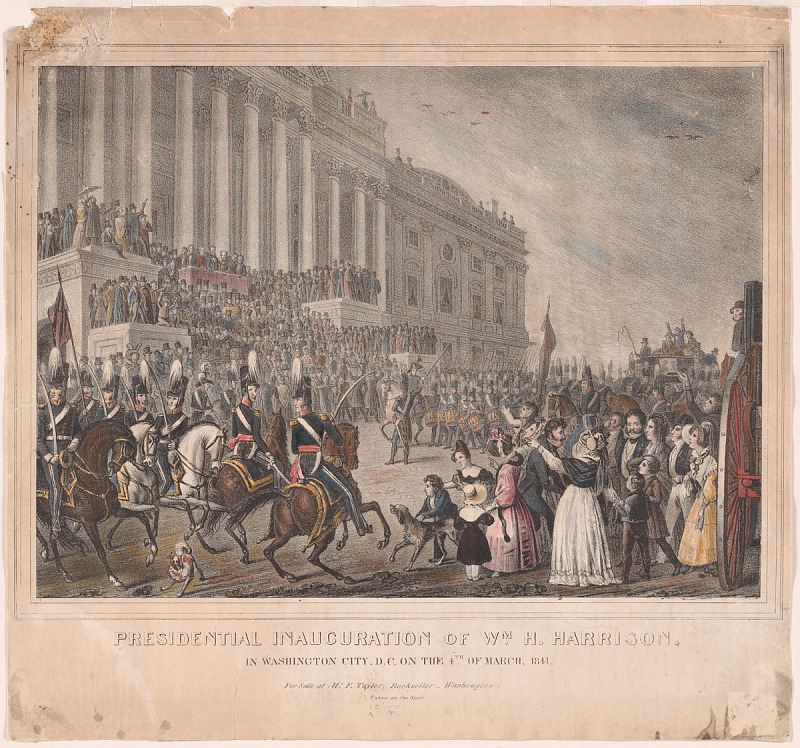
Harrison died after 31 days. Tyler immediately asserted the title, oath, authority, and responsibility of president.
Defining Decisions
Six Tests of Tyler’s Leadership
Claiming the Full Presidency
Tyler rejected proposals that the cabinet govern collectively or that he serve as “acting president.” He took the oath and returned mail addressed to any lesser title.
Vetoing the National Bank
He rejected two bank bills on constitutional and states’ rights grounds. His stand honored long-held beliefs but destroyed the Whig governing coalition.
Signing the Webster–Ashburton Treaty
The agreement settled much of the Maine–Canada boundary, addressed Great Lakes issues, and reduced the danger of war with Britain.
Facing an Impeachment Movement
House Whigs investigated Tyler after repeated vetoes. An impeachment resolution failed, but it was the first serious congressional effort to impeach a president.
Opening Relations With China
The Treaty of Wanghia secured trading rights and diplomatic access, expanding America’s commercial presence in the Pacific.
Securing Texas Annexation
After the Senate rejected a treaty, Tyler pursued a joint resolution requiring simple majorities. He signed it and sent Texas the offer just before leaving office.


Constitution & Power
Strict Construction With an Independent Executive
Tyler opposed broad federal legislative power while forcefully defending the constitutional independence of the presidency.
He denied that Congress could create the kind of national bank Clay wanted, used the veto repeatedly, resisted cabinet control, and asserted full succession. His presidency demonstrated that limited-government philosophy does not necessarily produce a weak executive. A president may reject broad federal programs while vigorously protecting the authority of his own branch.
“I am the President, and I shall be responsible for my administration.”John Tyler • Statement to Harrison’s Cabinet, 1841
The constitutional tension: Tyler defended strict procedures when vetoing domestic legislation, yet achieved Texas annexation by joint resolution after a treaty failed to obtain the constitutionally required two-thirds Senate vote. Whether Congress could annex a foreign republic this way was sharply disputed.
The Break With the Whigs
Principle, Stubbornness, and Political Collapse
The Whigs had formed largely in opposition to Andrew Jackson and expected President Harrison to cooperate with Henry Clay’s congressional program. Tyler shared their suspicion of executive overreach but not their economic nationalism. His opposition to a national bank was older than his Whig affiliation.
After Tyler’s second bank veto, every cabinet member except Secretary of State Daniel Webster resigned. The Whigs expelled the sitting president, refused to recognize him as their leader, and frustrated appointments. Tyler became a president without a reliable party in Congress.
His vetoes can be understood as principled constitutional acts, but his inability to negotiate a durable alternative also mattered. Fidelity to conviction preserved Tyler’s independence while making coherent domestic government nearly impossible.
The governing verdict
Tyler proved that an accidental president could exercise full authority. He did not prove that authority without coalition, persuasion, or party could produce an effective domestic program.
Texas, Expansion & Slavery
The Achievement That Deepened the National Crisis
Tyler believed annexing Texas would expand American power and secure the Southwest against British influence. It also offered him a cause around which to rebuild a political following. But Texas was a slaveholding republic, and annexation threatened to strengthen slave-state power.
Secretary of State John C. Calhoun explicitly connected annexation to the defense of slavery, making northern opposition stronger. Mexico warned that annexation would be treated as a hostile act. Tyler’s treaty failed decisively in the Senate, but he pressed Congress to use a joint resolution instead.
The resolution passed shortly before his term ended. Texas entered the Union under James K. Polk in December 1845, and unresolved boundary claims helped trigger the Mexican–American War in 1846.
The moral judgment: Annexation cannot be described only as territorial growth. Tyler’s campaign joined expansion to the preservation of slavery and transferred a dangerous international dispute to his successor.
Faith & Character
Conviction, Family, and Profound Contradiction
Episcopal Tradition
Raised in Virginia’s Episcopal culture, Tyler used the religious language of Providence but generally kept theological claims separate from political argument.
Unyielding Independence
He could sacrifice office, party, and popularity rather than obey instructions he believed unconstitutional. That courage could also harden into inflexibility.
Slaveholding
Tyler owned enslaved people throughout his adult life. His plantation, politics, and Texas policy were inseparable from a social order that denied liberty to others.
Personal Resilience
His first wife, Letitia, died in the White House. The Princeton disaster killed close advisers and Julia Gardiner’s father; Tyler later married Julia and fathered fifteen children across his two marriages.
After the Presidency
From Former President to Confederate Officeholder
As secession approached, Tyler initially chaired the Washington Peace Conference of 1861 in a failed effort to preserve the Union. After Virginia seceded, however, he embraced the Confederacy, served in its provisional congress, and won election to its House of Representatives.
Tyler died in Richmond in January 1862 before taking his Confederate seat. Because he had aligned himself against the United States, the federal government did not officially recognize his death. His coffin was draped with a Confederate flag.
A unique stain: Tyler remains the only former United States president to hold office in a government engaged in rebellion against the United States.
Presidential Scorecard
Tyler’s Record
Precedent-Setting
Established full presidential succession but used a disputed method to annex Texas.
Independent
Defended the veto, appointments, cabinet control, and authority of an unelected successor.
Obstruction Without Consensus
Blocked the Whig bank program but failed to build a durable replacement.
Substantive
Settled disputes with Britain, expanded trade in China, and annexed Texas.
Isolated
Preserved his principles but lost his party, cabinet, and congressional coalition.
Severely Damaged
Slaveholding, slavery-linked expansion, and later Confederate service weigh heavily.
Lasting Legacy
The Accidental President Who Made Succession Work
Tyler’s immediate assumption of the full presidency was bold, stabilizing, and lasting. By refusing the status of caretaker, he prevented prolonged uncertainty and supplied a practical answer the Constitution had left unclear.
Yet the same independence that served the country in succession produced political paralysis in domestic affairs. His foreign-policy achievements were real, but Texas annexation intensified both the expansion of slavery and the confrontation with Mexico.
Final assessment
John Tyler’s finest constitutional act secured the presidency; his darkest political choices helped divide the nation. He deserves credit for orderly succession and capable diplomacy, but his record is diminished by slavery, sectional expansion, and his final allegiance to the Confederacy.
Sources & Further Reading
Trace the Evidence
- Miller Center: John Tyler
- White House Historical Association: John Tyler
- Library of Congress: John Tyler Resource Guide
- United States Senate: John Tyler
- National Constitution Center: Twenty-Fifth Amendment
- Office of the Historian: Texas Annexation
- Office of the Historian: Webster–Ashburton Treaty
- Office of the Historian: Treaty of Wanghia