2nd President • 1797–1801
John Adams
A fierce advocate for independence and constitutional government, Adams preserved peace when war fever threatened the young republic—but damaged his presidency by signing laws that punished political dissent.

Why He Matters
The President Who Chose Peace Over His Party
Adams inherited a nation divided between Britain and France abroad and Federalists and Democratic-Republicans at home. His presidency became an early test of whether national security could be defended without sacrificing republican liberty.
Voice for Independence
Before the presidency, Adams became one of Congress’s most forceful advocates for separation from Britain. He helped secure support for independence, served on the committee that drafted the Declaration, and defended the new nation as a diplomat.
Constitutional Thinker
Adams believed liberty required balanced government, independent courts, divided powers, and institutions strong enough to restrain ambition. His ideas influenced the Massachusetts Constitution and the broader American constitutional tradition.
Peace With France
Despite political pressure for full-scale war, Adams reopened negotiations with France. The Convention of 1800 ended the undeclared naval conflict and cost Adams support within his own Federalist Party.
Peaceful Transfer
After losing the bitter election of 1800, Adams relinquished office to Thomas Jefferson. The transfer between rival parties showed that constitutional succession could survive intense political conflict.
The Road to the Presidency
Lawyer, Revolutionary, Diplomat
Adams defended the British soldiers accused after the Boston Massacre. He believed the rule of law required legal representation even for unpopular defendants; six soldiers were acquitted and two were convicted of manslaughter.
As a delegate to the Continental Congress, Adams pressed for independence, nominated George Washington to command the Continental Army, and served on the Committee of Five.
Diplomatic service in France, the Netherlands, and Britain helped Adams secure recognition, loans, and peace. He became the first American minister to Great Britain.
Adams served two terms as the nation’s first vice president. The office frustrated him, but his Senate tie-breaking votes helped shape the first federal government.
He succeeded Washington after the first contested presidential election and inherited growing conflict with revolutionary France.

Defining Decisions
Six Tests of Adams’s Leadership
Seeking Diplomacy With France
French attacks on American shipping created pressure for retaliation. Adams sent envoys to negotiate, beginning the chain of events that produced the XYZ Affair.
Preparing for the Quasi-War
After French intermediaries demanded payments before negotiations, public outrage surged. Adams strengthened maritime defenses, signed legislation creating the Department of the Navy, and supported an expanded army without asking Congress for a formal declaration of war.
Signing the Alien and Sedition Acts
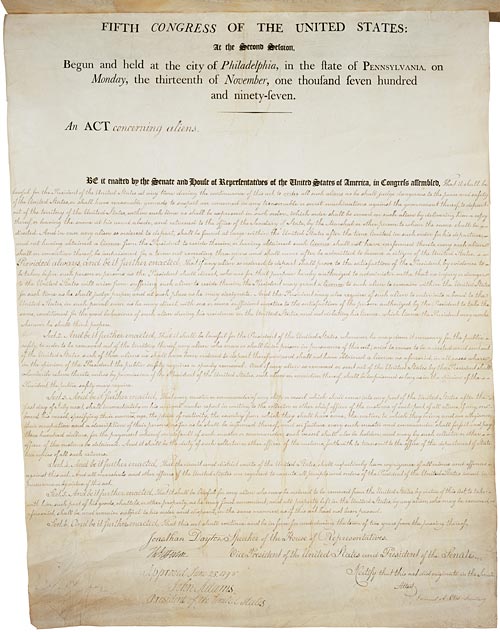
The laws increased federal authority over noncitizens and criminalized certain attacks on the government. Federalists used the Sedition Act against opposition journalists and a member of Congress. The measures remain the clearest constitutional and moral failure of Adams’s presidency.
Sending a Second Peace Mission
Adams nominated another diplomatic mission after learning that France might negotiate. Leading Federalists opposed him, but he placed national peace above party unity.
Accepting the Convention of 1800
The agreement ended the Quasi-War and dissolved the old alliance obligations with France. Adams later regarded the peaceful settlement as one of his greatest achievements.
Appointing John Marshall
Adams named Marshall chief justice during his final months in office. Marshall’s long tenure strengthened the Supreme Court and profoundly shaped constitutional law.

Constitution & Power
A Defender of Institutions Who Failed a Test of Liberty
Adams understood constitutional structure better than most founders, yet fear and party conflict led him to approve an assault on freedom of political expression.
His administration operated within the new constitutional system: Congress enacted the disputed laws, courts heard prosecutions, and elections removed the governing party. But formal legality did not make the Sedition Act compatible with the First Amendment’s purpose. Adams’s record shows that constitutional government can be endangered not only by a dictator, but also by elected officials who persuade themselves that dissent threatens national survival.
Faith & Character
Religion, Morality, and Public Duty
A Religious View of Republican Government
Raised in New England Congregationalism, Adams believed moral character was essential to self-government. His theology developed in a more liberal direction than traditional Calvinism, but his public writings consistently connected liberty with virtue, responsibility, and accountability before God.
Character Without Easy Charm
Adams was intelligent, courageous, industrious, and deeply devoted to public service. He could also be vain, irritable, suspicious, and politically abrasive. His partnership and correspondence with Abigail Adams reveal both his dependence on her judgment and the human costs of decades spent in public duty.
“Our Constitution was made only for a moral and religious People.”John Adams • Address to the Massachusetts Militia, 1798
Slavery and Human Equality
Personal Opposition Without National Leadership
Adams’s record differs sharply from that of many founders, but it should still be judged with precision.
John and Abigail Adams did not own enslaved people, and their households generally employed white and free Black workers. Adams expressed opposition to slavery and described it as a corrupting institution. As president, his administration also supported trade with Toussaint Louverture during the Haitian Revolution.
Yet Adams was not a national abolitionist. He did not make emancipation a central political cause, and he accepted compromises that allowed slavery to remain embedded in the Union. Enslaved laborers also helped construct the President’s House that John and Abigail occupied in 1800. Personal refusal to own human beings was morally significant, but it was not the same as using national influence to dismantle the institution.
Historical judgment requires a distinction: Adams did not participate in slaveholding as Washington and Jefferson did, but his opposition remained more private and philosophical than politically transformative.
Presidential Scorecard
Adams’s Record
Serious Thinker
Defended balanced government, independent courts, and institutional restraint.
Crisis Expansion
Accepted greater federal authority during conflict with France and signed the Alien and Sedition Acts.
Courageous Peace
Avoided a full war with France despite public fury and opposition within his own party.
Federalist Continuity
Generally continued Washington-era financial policies while military preparations increased spending and taxes.
Principled but Combative
Showed independence and integrity, but often damaged his own leadership through pride and political mistrust.
Political Repression
The Sedition Act punished opposition speech and betrayed a central liberty of republican government.
Lasting Legacy
The Independent Patriot
John Adams’s presidency is often overshadowed by Washington before him and Jefferson after him. Yet Adams faced a decision that has destroyed many governments: whether to allow foreign conflict and domestic anger to pull the country into unnecessary war. He resisted that pressure and sacrificed his standing within the Federalist Party to preserve peace.
His record also carries a warning. A leader may be devoted to constitutional government and still violate constitutional liberty when fear, national-security claims, and partisan hatred converge. Adams’s greatness and failure arose from the same turbulent presidency, making him one of the most instructive figures in the history of executive power.
Final assessment
John Adams preserved the republic abroad but weakened its liberty at home. His successful diplomacy with France, commitment to law, opposition to slavery, judicial legacy, and peaceful surrender of office deserve lasting honor. The Alien and Sedition Acts deserve lasting condemnation.

Sources & Further Reading
Trace the Evidence
- National Park Service: John Adams, 1735–1826
- U.S. Department of State: The XYZ Affair and Quasi-War
- National Archives: Alien and Sedition Acts
- White House Historical Association: John Adams
- White House Historical Association: The Households of John Adams
- Massachusetts Historical Society: The Adams Papers