35th President • 1961–1963
John F. Kennedy
Kennedy called Americans to public service, committed the nation to a Moon landing, and confronted a nuclear crisis over Cuba. His short presidency combined inspiring ambition with consequential failures, a growing commitment to civil rights, and unresolved questions about American power abroad.


Why He Matters
An Unfinished Presidency With a Lasting Reach
Nuclear Crisis Leadership
His handling of the Cuban Missile Crisis combined military pressure with negotiation to avert a catastrophic war.
The Moon Challenge
His lunar goal gave NASA a defining mission and mobilized a national scientific effort.
Civil Rights
His administration enforced integration and eventually proposed sweeping legislation, while activists pressed it to act faster.
Faith and Public Office
As the first Catholic president, Kennedy challenged religious barriers to national leadership.
The Road to the Presidency
From Brookline to the White House
Born in Brookline, Massachusetts, Kennedy grew up in a prominent family and graduated from Harvard in 1940.
He served in the Navy during World War II. His leadership after the sinking of PT-109 became an important part of his public reputation.
Elected to the House of Representatives in 1946, he won a Massachusetts Senate seat in 1952 and married Jacqueline Bouvier in 1953.
He defeated Richard Nixon in a close election marked by televised debates and controversy over Kennedy’s Catholic faith.
At age 43, he became the youngest person elected president. Theodore Roosevelt had become president at a younger age through succession.
Source: JFK Library: Life of John F. Kennedy.
Defining Decisions
Six Tests of Kennedy’s Leadership
Approving the Bay of Pigs
He authorized an invasion by CIA-trained Cuban exiles. Its failure exposed serious flaws in planning and presidential judgment.
Creating the Peace Corps
He established a program that sent American volunteers abroad for development and service.
Setting the Lunar Goal
He asked Congress to commit the nation to landing a person on the Moon and returning safely before the decade ended.
Choosing a Naval Quarantine
He used naval pressure and diplomacy to confront Soviet nuclear missiles in Cuba.
Calling for Civil-Rights Legislation
He made a public moral argument for equality and submitted a major civil-rights bill to Congress.
Pursuing a Test Ban
His administration negotiated an agreement limiting nuclear weapons testing.
Constitution & Power
Enforcing Integration and Seeking Legislation
In 1962, James Meredith sought to enroll at the University of Mississippi under federal court orders. State resistance and a violent riot turned the dispute into a test of federal authority. Kennedy federalized the Mississippi National Guard and deployed federal forces; Meredith enrolled on October 1.
In June 1963, his administration confronted Alabama Governor George Wallace’s obstruction of university integration. That evening, Kennedy addressed the nation about civil rights.
Enforcement and legislation serve different purposes.
The president could uphold court orders and administer existing law. Broader protections required Congress to act. Kennedy’s eventual legislative proposal recognized that executive enforcement alone could not secure equal citizenship.
Source: Miller Center: Domestic Affairs.
Military Service
PT-109 and Responsibility Under Pressure
In August 1943, a Japanese destroyer struck Kennedy’s patrol torpedo boat, PT-109, in the Solomon Islands. Two crew members died. Kennedy helped the survivors reach safety, including assisting a badly burned sailor through the water.
Solomon Islanders Biuku Gasa and Eroni Kumana played essential roles in locating the survivors and carrying a message that helped bring rescue. Kennedy’s courage belongs within that larger story of teamwork and local assistance.
Source: JFK Library: Kennedy and PT-109.
Cuba
The Bay of Pigs: A Failure of Judgment
The CIA-backed invasion began on April 17, 1961. Cuban exiles landed at the Bay of Pigs, but Castro’s forces defeated the operation within days. Kennedy had inherited planning from the Eisenhower administration and made the decision to proceed.
The failure damaged American credibility and strengthened Castro’s position. Subsequent covert efforts against the Cuban government continued to deepen hostility.
The leadership lesson: A president remains responsible for examining assumptions, asking difficult questions, and judging whether advisers’ plans can achieve their stated goals.
The Cuban Missile Crisis
Thirteen Days at the Edge of Nuclear War
In October 1962, reconnaissance photographs revealed Soviet nuclear missile sites in Cuba. Kennedy considered air strikes and invasion but chose a naval quarantine to stop further offensive weapons deliveries.
Public firmness was accompanied by private negotiation. The Soviet Union agreed to remove its missiles from Cuba; the United States publicly pledged not to invade Cuba and privately agreed to remove Jupiter missiles from Turkey.
The settlement averted war, but it was a negotiated compromise. Nuclear danger arose within a wider cycle of threats, covert operations, and competing security fears.
Strength required room for an agreement.
Kennedy’s achievement was resisting immediate escalation while preserving a route to settlement. The crisis illustrates the importance of deliberation when military action could have irreversible consequences.
Diplomacy
Reducing the Danger of Nuclear Testing
The 1963 Limited Test Ban Treaty prohibited nuclear weapons tests in the atmosphere, outer space, and underwater. It allowed underground testing and did not end the arms race.
Negotiated with the Soviet Union and the United Kingdom, the treaty received Senate consent to ratification. It represented a practical step toward limiting radioactive fallout and easing tensions after the Cuban crisis.
The constitutional process: Presidential negotiation and the Senate’s treaty role worked together. Diplomacy became binding policy through the constitutional ratification process.
The Space Program
A National Commitment to Reach the Moon
On May 25, 1961, Kennedy asked Congress to commit the United States to landing a person on the Moon and returning safely before the end of the decade. At Rice University on September 12, 1962, he rallied public support for that goal.
The challenge joined scientific exploration with Cold War competition. It required sustained funding, engineering, and work by thousands of people across successive administrations.
Apollo 11 fulfilled the landing goal in July 1969, during Richard Nixon’s presidency. Kennedy supplied the defining commitment; others carried it through.
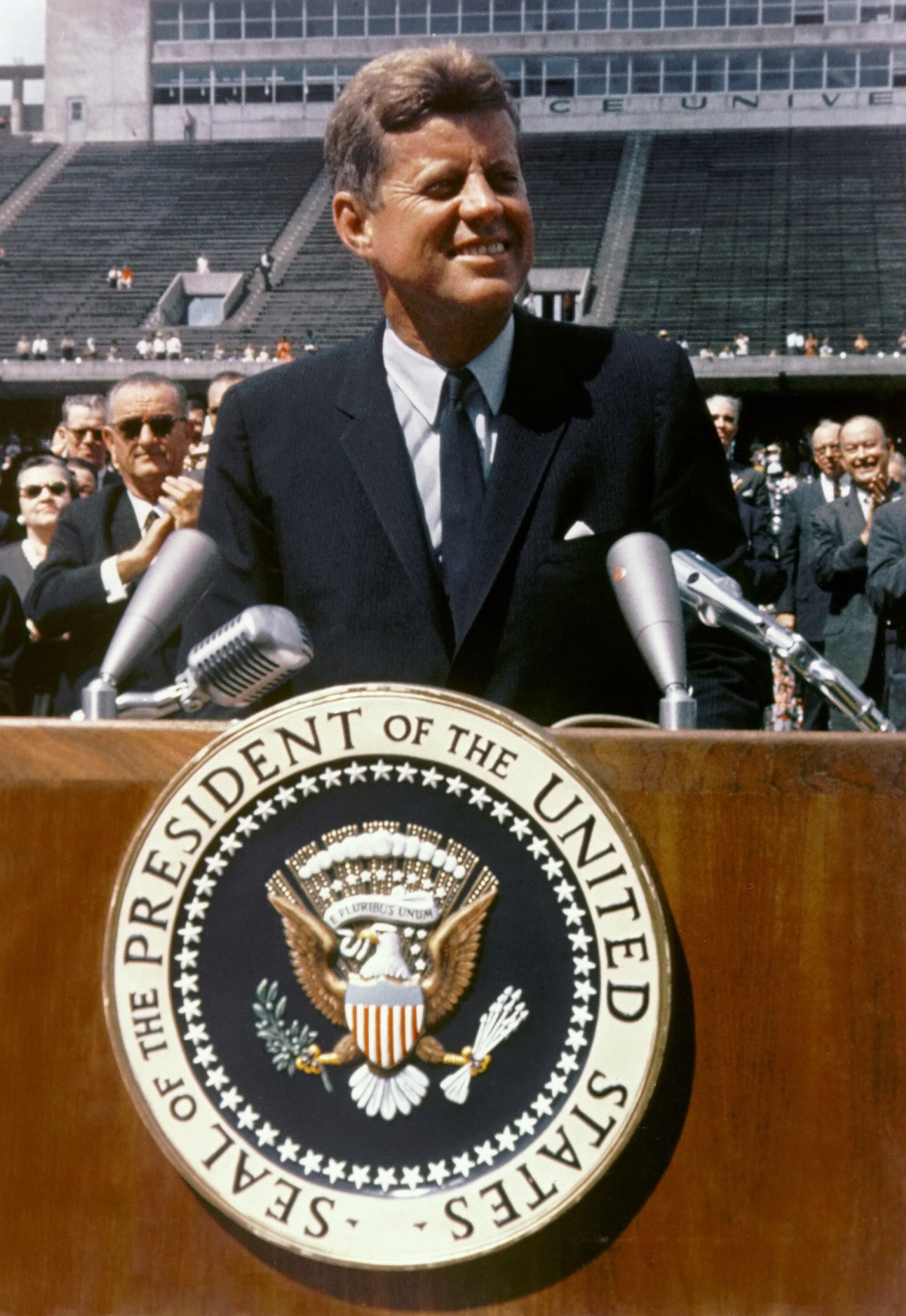

Source: NASA: Kennedy’s Moon-Landing Goal.
Civil Rights
From Caution to a Public Moral Commitment
Kennedy initially approached civil rights cautiously, balancing enforcement with concern about congressional opposition. Freedom Riders, student activists, and the broader movement demanded more urgent action.
On June 11, 1963, he presented racial equality as a moral responsibility of the nation. He submitted comprehensive civil-rights legislation later that month.
The bill had not become law when he died. Lyndon Johnson signed the Civil Rights Act on July 2, 1964, after a major congressional struggle. Credit belongs to activists, lawmakers, and both administrations.
Source: JFK Library: Civil-Rights Address.
Economy
The New Frontier and Congressional Resistance
Kennedy took office during a recession and sought to stimulate growth through spending, a higher minimum wage, and proposed tax reductions. His New Frontier also called for expanded education and health programs.
Congress resisted several major proposals, including medical insurance for older Americans. The large tax reduction he advocated passed in 1964 under Johnson; Medicare followed in 1965.
His domestic record therefore includes both enacted measures and an agenda completed or reshaped by his successor.
Source: Miller Center: Domestic Affairs.
Work & Equal Opportunity
Signing the Equal Pay Act
On June 10, 1963, Kennedy signed the Equal Pay Act, addressing sex-based wage discrimination for equal work under the law’s standards. The measure amended the Fair Labor Standards Act.
The legislation followed advocacy by women’s organizations and work by administration officials, including Esther Peterson. It established a federal protection while leaving further battles over workplace equality ahead.
Source: National Archives: Equal Pay.
Service & Foreign Policy
The Peace Corps and the Vietnam Commitment
Kennedy created the Peace Corps by executive order in 1961, and Congress subsequently authorized the program. Volunteers worked in education, health, and development abroad, connecting public service with American foreign policy.
In Vietnam, he expanded American military assistance and the advisory presence supporting South Vietnam. His presidency deepened a commitment that his successor would escalate dramatically.
Historical caution: Whether Kennedy would have withdrawn from Vietnam or expanded the war if he had lived cannot be established with certainty. Withdrawal planning must be weighed alongside his continuing commitment to South Vietnam.
Source: Miller Center: Foreign Affairs.
Source: Miller Center: The Vietnam Debate.
Civil Liberties
Civil-Rights Advocacy and Federal Surveillance
During Kennedy’s presidency, Attorney General Robert Kennedy authorized FBI wiretapping of Martin Luther King Jr. The decision belongs in an assessment of the administration’s civil-liberties record alongside its support for civil-rights legislation.
Later congressional investigations scrutinized the surveillance and the FBI’s wider campaign against King. Those activities extended beyond Kennedy’s lifetime and should not all be attributed to him personally.
The accountability question: Government support for equality does not excuse unjustified intrusion into the lives of people campaigning for it. Security claims require evidence, safeguards, and oversight.
Source: National Archives: Congressional Findings on King Surveillance.
Faith & Character
The First Catholic President
Breaking a Religious Barrier
Kennedy’s election demonstrated that Catholic identity need not disqualify a citizen from the nation’s highest office.
The Houston Address
He argued for religious liberty, separation of church and state, and a president accountable to constitutional duties rather than ecclesiastical direction.
A Call to Responsibility
His public message asked citizens to contribute to national life, connecting leadership with duties beyond personal advantage.
Words and Consequences
Inspiring rhetoric deserves examination alongside policy outcomes, errors, and the rights of those affected by presidential decisions.
Source: JFK Library: Houston Address.
Presidential Scorecard
Kennedy’s Record
These assessments are editorial judgments based on the record discussed above.
Enforcement With Legislative Limits
His integration actions upheld federal authority; wider civil-rights protections still required Congress.
Consequential and Uneven
Crisis management showed deliberation, while covert operations and surveillance require critical scrutiny.
An Agenda Partly Unfinished
He supported recovery and workplace reform, but major tax and health proposals passed after his death.
Growth After Early Failure
Bay of Pigs exposed poor judgment; the missile settlement and test ban demonstrated more measured leadership.
A Significant Shift
His public commitment strengthened the cause, though activists had to overcome administration caution.
An Enduring Call to Service
The Peace Corps and lunar goal gave lasting institutional form to his appeal for public purpose.
The Presidency Ends
Dallas and the Transfer of Power
Kennedy was assassinated in Dallas, Texas, on November 22, 1963, while traveling in a presidential motorcade. He was 46 years old.
Lyndon Johnson took the presidential oath that day. The transfer of authority preserved constitutional continuity during national shock and grief.
Kennedy was buried at Arlington National Cemetery. His death shaped public memory of a presidency whose ambitions, achievements, and limitations must still be assessed on their own evidence.
Source: JFK Library: Life of John F. Kennedy.
Final Assessment
Ambition, Crisis, and an Unfinished Record
The legacy
Kennedy’s strongest achievements combined ambition with practical judgment: a negotiated escape from nuclear crisis, a limited test ban, and institutions devoted to service and exploration. Bay of Pigs, deepening involvement in Vietnam, and surveillance remain serious parts of the same record.
His presidency was brief enough that promise often outweighs completed policy in public memory. A fair assessment distinguishes what he accomplished, what others completed, and what history cannot tell us about the choices he would have made.
Return to All PresidentsSources & Further Reading
Historical Records Behind This Profile
Section links identify the supporting research. Both photographs are historical images, with credits and public-domain status in the United States documented on their linked image pages.
- John F. Kennedy Presidential Library and Museum — biography, military service, speeches, and presidential records.
- U.S. Department of State, Office of the Historian — Cuba, diplomacy, and treaty history.
- National Archives — civil-rights legislation, equal pay, and congressional investigations.
- NASA History — Kennedy’s lunar commitment and Rice University speech.
- Miller Center — domestic policy, foreign affairs, and scholarly assessment.