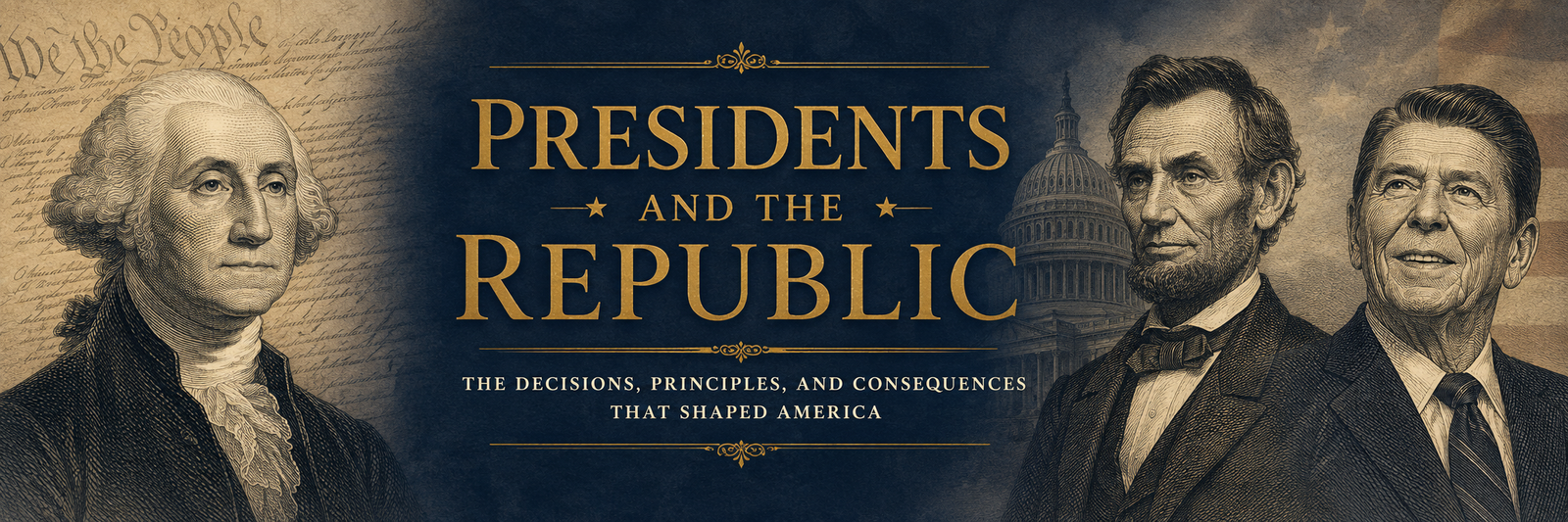
40th President • 1981–1989
Ronald Reagan
Reagan reshaped American conservatism through lower tax rates, a stronger national defense, and an optimistic defense of freedom. His presidency helped move the Cold War toward a negotiated end, while deficits, Iran-Contra, and failures in public health exposed the limits of his leadership.


Why He Matters
The President Who Recast the American Debate
A Conservative Realignment
Reagan joined free-market advocates, religious conservatives, defense hawks, and disaffected Democrats in a durable national coalition. He made skepticism toward federal power central to Republican politics.
A New Economic Direction
Tax reductions and deregulation shifted the policy debate toward incentives, investment, and private enterprise. Recovery followed a severe recession, but prosperity came with persistent deficits and uneven gains.
Pressure and Diplomacy
Reagan strengthened American military capabilities and challenged Soviet communism, then worked with Mikhail Gorbachev to reduce nuclear dangers.
The Power of Communication
His speeches connected policy to a story of national renewal. Supporters saw restored confidence; critics argued that reassuring language sometimes concealed unresolved problems.
The Road to the Presidency
From Illinois to Hollywood to Sacramento
Born in Tampico, Illinois, Reagan grew up principally in Dixon and graduated from Eureka College. He later worked as a radio sports announcer.
A Hollywood film career and service as president of the Screen Actors Guild developed his public presence. During World War II, he served in an Army motion-picture unit in the United States.
A former Democrat, Reagan became a Republican. His televised address supporting Barry Goldwater in 1964 brought national attention to his conservative message.
As governor of California, he confronted campus unrest and budget pressures. His record included both conservative priorities and compromises, including tax increases.
Reagan challenged President Gerald Ford for the Republican nomination and narrowly lost, strengthening his standing among party conservatives.
He defeated Jimmy Carter amid inflation, economic anxiety, and the Iran hostage crisis. George H. W. Bush became his vice president.
America He Inherited
A Country Looking for Renewal
When Reagan took office on January 20, 1981, Americans faced the aftermath of oil shocks, stubborn inflation, and declining trust in national leadership. The Iran hostage crisis had exposed the limits of American influence overseas, while the Soviet invasion of Afghanistan sharpened Cold War tensions. The hostages were released on inauguration day, after an agreement negotiated by the Carter administration.
Reagan offered a clear political response: reduce the burden of federal government, rebuild military strength, and restore confidence in the country’s future. His challenge was to turn that message into policy while Democrats retained control of the House of Representatives.
Defining Decisions
Six Tests of Reagan’s Leadership
Cutting Federal Taxes
The Economic Recovery Tax Act reduced individual income-tax rates over several years and changed business taxation. Reagan argued that stronger incentives would expand production and investment.
Firing Striking Controllers
After an illegal strike by federal air traffic controllers, Reagan dismissed those who refused to return. The confrontation became a defining assertion of executive resolve and a major defeat for organized labor.
Proposing Missile Defense
The Strategic Defense Initiative sought defenses against ballistic missiles. Its ambition unsettled Soviet leaders and critics who questioned its feasibility and effect on arms control.
Compromising on Social Security
Reagan signed bipartisan legislation combining revenue increases and benefit changes, including a gradual increase in the full retirement age, to address the system’s financing crisis.
Reforming the Tax Code
The Tax Reform Act lowered statutory rates while eliminating many deductions and preferences. It demonstrated that a conservative president and a divided Congress could reach a major legislative agreement.
Signing the INF Treaty
Reagan and Gorbachev agreed to eliminate an entire category of U.S. and Soviet ground-launched missiles, with verification provisions that advanced nuclear arms control.
Constitution & Power
Limited Government and a Powerful Presidency
Reagan sought to restrain domestic government while strengthening presidential direction.
His administration used appointments, regulatory review, executive orders, and national-security authority to pursue its priorities. The result was a recurring tension between limited-government principles and vigorous executive action.
Judicial appointments extended his influence beyond his terms. He appointed Sandra Day O’Connor, the first woman on the Supreme Court, as well as Antonin Scalia and Anthony Kennedy, and elevated William Rehnquist to chief justice. Their records did not always align with conservative expectations.
The constitutional test: Iran-Contra raised the sharpest questions about congressional control of funding, covert operations, and executive accountability. Presidential policy goals did not remove the obligation to obey statutory limits.
Economy
Reaganomics: Recovery, Incentives, and Debt
Reagan entered office amid high inflation and weak economic confidence. His program emphasized tax reductions, restraint in domestic spending, deregulation, and support for reducing inflation. Federal Reserve chairman Paul Volcker’s tight monetary policy was crucial to disinflation and also contributed to the painful 1981–1982 recession.
A sustained expansion followed. Employment and output grew, inflation fell substantially from its earlier peaks, and Reagan won reelection in 1984 by carrying 49 states. Monetary policy, the business cycle, energy prices, and congressional decisions all mattered alongside White House policy.
Lower Rates, Later Adjustments
Reagan lowered the top statutory individual income-tax rate dramatically across his presidency. The top rate fell from 70 percent when he took office to 28 percent by 1988. He also signed revenue-raising measures, complicating the idea that his record consisted entirely of tax cuts.
The Unfinished Promise
Defense spending increased, major entitlement programs endured, and federal borrowing remained substantial. Tax cuts did not fully pay for themselves; the national debt rose sharply.
A Stronger Market Emphasis
The administration reduced or redirected federal regulation in several sectors. Some deregulation had begun before Reagan, and later financial problems exposed weaknesses in supervision.
An Uneven Expansion
Many Americans benefited from growth and lower inflation. Others experienced industrial displacement, weaker union bargaining power, or hardship from changes to domestic programs.
The economic judgment: Reagan helped establish a lasting preference for lower marginal tax rates and market incentives. His record also shows how difficult it is to combine tax cuts, military expansion, popular benefits, and balanced budgets.
War & Foreign Policy
Confronting Communism, Then Negotiating

Reagan treated the Cold War as a contest over political freedom and human dignity. His administration expanded defense capabilities, supported anti-communist movements, and challenged Soviet influence. Those policies reassured some allies while intensifying fears of escalation.
His later diplomacy was equally consequential. Beginning with the 1985 Geneva summit, Reagan and Gorbachev developed a working relationship that enabled negotiations even when they disagreed profoundly. The 1986 Reykjavik summit failed to produce a sweeping nuclear agreement but helped prepare the way for the INF Treaty.
The Berlin Challenge
At the Brandenburg Gate in June 1987, Reagan challenged Gorbachev to remove the Berlin Wall. The speech became a lasting symbol of opposition to communist repression.
Grenada
The 1983 invasion removed a Marxist military government. Reagan cited American citizens’ safety and regional security; critics challenged the operation’s legality and necessity.
Lebanon and Libya
The 1983 Beirut barracks bombing killed 241 U.S. service members, exposing the dangers of an uncertain peacekeeping mission. Reagan later ordered strikes against Libya in 1986 following a terrorist bombing in West Berlin.
The Reagan Doctrine
Support for anti-communist forces in Afghanistan, Nicaragua, and elsewhere imposed costs on Soviet-aligned governments. It also entangled Washington with armed groups and governments implicated in serious abuses.


Credit and context: The Berlin Wall fell in November 1989, after Reagan left office; the Soviet Union dissolved in 1991. His pressure and diplomacy contributed to change alongside Gorbachev’s decisions, Soviet economic weakness, allied policy, and popular movements.
Iran-Contra
A Policy Goal Cannot Override the Law
The Iran-Contra affair joined secret arms dealings with Iran to efforts to support Nicaragua’s Contra rebels. Some proceeds from arms sales were diverted to the Contras amid congressional restrictions on U.S. assistance. The scandal became public in 1986.
Reagan had approved the Iran initiative, but his knowledge of the diversion was not established. Investigations revealed failures of supervision, secrecy, and accountability within the national-security apparatus. Disputes about particular officials’ criminal liability did not erase the larger failure of governance.
In a March 1987 address, Reagan accepted responsibility and acknowledged that an initiative presented as an opening to Iran had deteriorated into trading arms for hostages. His response included personnel changes and changes to National Security Council procedures.
The central failure
Delegating responsibility did not relieve the president of the duty to supervise his administration. Iran-Contra remains the strongest challenge to Reagan’s record of constitutional leadership.
Domestic Challenges
Public Health, Civil Rights, Immigration, and Drugs
The AIDS Crisis
The federal government expanded research and funding during the epidemic, but Reagan’s public leadership came late. His administration’s early response failed to match the crisis’s urgency, and stigma deepened the suffering of affected communities.
The War on Drugs
Reagan signed legislation expanding drug enforcement and mandatory penalties. Nancy Reagan promoted prevention. Punitive policies contributed to incarceration and sentencing disparities that later drew bipartisan criticism.
The 1986 Compromise
The Immigration Reform and Control Act combined legalization for qualifying undocumented immigrants with employer sanctions and enforcement measures. Persistent unauthorized immigration exposed weaknesses in implementation.
Conflicting Signals
Reagan signed the extension of the Voting Rights Act and the law establishing the Martin Luther King Jr. holiday. His administration also opposed several civil-rights measures and defended policies critics considered damaging to racial equality.
Faith & Character
Religious Conviction and Public Responsibility
A Christian Worldview
Raised in the Disciples of Christ tradition, Reagan often spoke of providence, religious liberty, and moral responsibility. He linked freedom of conscience to his criticism of communist government.
A Changed Public Position
As California governor, he signed a law liberalizing abortion access in 1967. As president, he opposed abortion and supported constitutional protection for unborn life, a shift central to his relationship with religious conservatives.
Optimism and Resilience
Reagan survived an assassination attempt on March 30, 1981. His humor and composure strengthened his public image, while his optimistic speaking style helped him communicate through political setbacks.
Delegation and Distance
He set broad goals and often entrusted details to aides. That approach could empower capable advisers, but it also allowed serious problems to develop without adequate presidential scrutiny.
Presidential Scorecard
Reagan’s Record
These assessments are editorial judgments based on the record, rather than numerical rankings.
An Uneven Record
Judicial appointments and institutional change left a durable imprint, while Iran-Contra revealed serious failures of executive accountability.
Strong Direction, Weak Oversight
Reagan commanded the public agenda effectively but did not consistently supervise the machinery carrying out his policies.
Growth With Fiscal Costs
Expansion and lower inflation improved confidence; persistent deficits and unequal gains complicated the achievement.
A Major Strategic Contribution
Military pressure and negotiation helped transform U.S.–Soviet relations, alongside costly regional interventions.
Transformative
His coalition and communication reshaped Republican priorities and influenced the national debate long after 1989.
Inspiring and Contested
His defense of freedom and opposition to Soviet repression stand alongside failures in public health and troubling foreign-policy partnerships.
After the White House
Retirement, Illness, and National Mourning
Reagan left office on January 20, 1989, succeeded by George H. W. Bush. In 1994, he publicly announced that he had been diagnosed with Alzheimer’s disease, bringing renewed attention to an illness that increasingly shaped his retirement.
He died on June 5, 2004, at age 93. National mourning reflected his stature as a consequential president, even as Americans continued to debate the costs and achievements of his policies.
Lasting Legacy
Freedom, Confidence, and the Burden of Accountability
Reagan changed the terms of American politics. He made lower taxes, private enterprise, a strong defense, and national confidence central to a renewed conservative movement. He also demonstrated that ideological conviction could coexist with consequential compromise.
His best foreign-policy achievement lay in combining pressure with an eventual willingness to negotiate. His greatest governing failure showed the danger of allowing secrecy and delegation to outrun lawful oversight.
Final assessment
Ronald Reagan was a transformative president whose influence rests on conservative realignment, economic change, and a significant contribution to the Cold War’s peaceful conclusion. A fair assessment must also weigh borrowing, social costs, the AIDS response, and Iran-Contra. His presidency demonstrates both the reach of persuasive leadership and the need to match conviction with responsible administration.
Sources & Further Reading
Trace the Evidence
- Reagan Library: Berlin Wall speech photographs
- Reagan Library: summit photographs and dates
- Ronald Reagan Presidential Library: Biography and archival resources
- Ronald Reagan Presidential Library: The Reagan Presidency
- Miller Center: Domestic Affairs
- Miller Center: Key Events
- U.S. Department of State: The Presidency of Ronald W. Reagan
- Reagan’s March 4, 1987 address on Iran-Contra
- National Archives: Reagan and the Economy
- U.S. Department of Labor: Reagan Administration