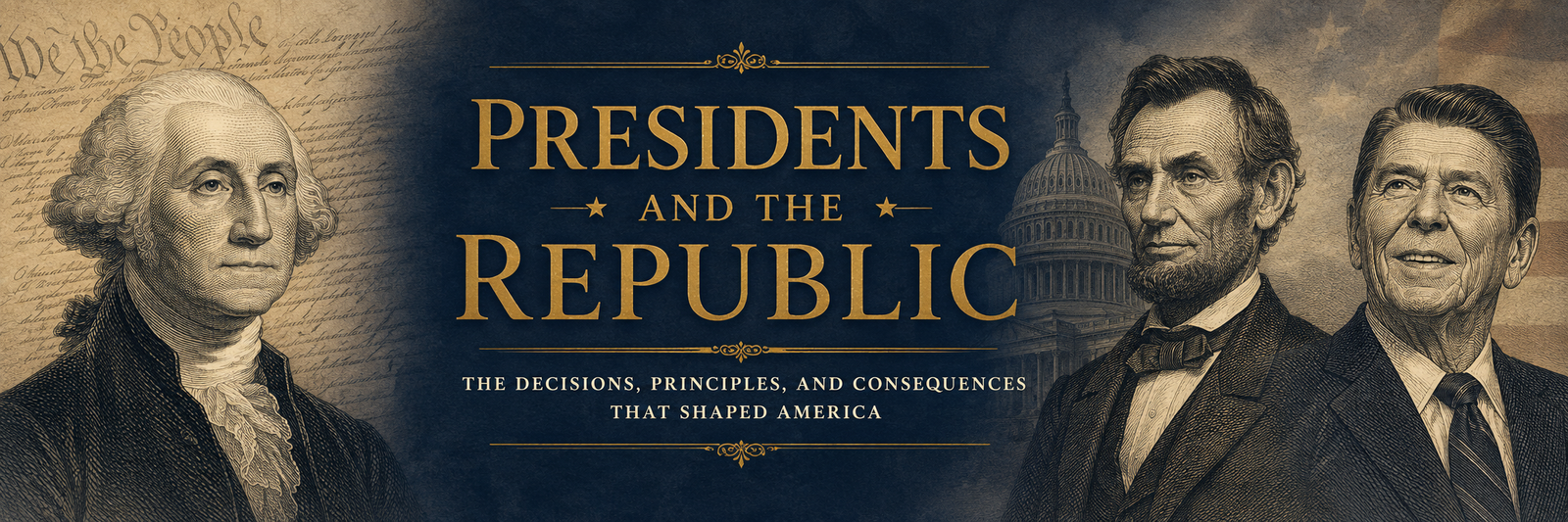
16th President • 1861–1865
Abraham Lincoln
Lincoln entered office as the Union fractured and became the defining wartime president. He preserved the republic, transformed the war into a struggle against slavery, enlarged executive power under emergency, and gave enduring language to the American promise of liberty and equality.

Why He Matters
The President Who Preserved the Union and Destroyed Slavery
No president faced a greater test of whether constitutional government could survive rebellion, civil war, and moral transformation.
Preserving the Union
Lincoln rejected the claim that a state could leave the United States through unilateral secession and led the nation through four years of civil war.
Emancipation
The Emancipation Proclamation made freedom a Union war aim and authorized Black military service, while the Thirteenth Amendment permanently abolished slavery.
Wartime Executive Power
He called troops, expanded the military, spent funds, blockaded Southern ports, and suspended habeas corpus before or beyond explicit congressional authorization.
National Meaning
The Gettysburg Address and Second Inaugural recast the war as a test of equality, democratic government, judgment, mercy, and national rebirth.
The Road to the Presidency
From the Frontier to the Crisis of the Union
Born in Kentucky and raised in Indiana, Lincoln grew up in a farming family with little formal schooling and educated himself through intensive reading.
He served four terms in the Illinois legislature, became a lawyer, and emerged as a Whig advocate of economic development and constitutional government.
During one term in the U.S. House, Lincoln criticized President James K. Polk’s justification for the Mexican–American War.
The Kansas–Nebraska Act drew him back into national politics. He condemned slavery’s expansion while acknowledging constitutional limits where slavery already existed.
His debates with Stephen A. Douglas made him nationally prominent. Lincoln lost the Senate contest but sharpened the moral and constitutional case against slavery’s spread.
Republicans nominated Lincoln as a broadly acceptable candidate. He won a four-way election without carrying a Southern state.
Defining Decisions
Six Tests of Lincoln’s Leadership
Refusing to Abandon Fort Sumter
Lincoln sent provisions to the federal garrison while notifying South Carolina that the mission was peaceful unless attacked. Confederate batteries opened fire.
Mobilizing Without Congress
With Congress out of session, he called militia, expanded the armed forces, declared a blockade, and authorized emergency spending.
Suspending Habeas Corpus
Lincoln authorized military officers to suspend the writ along vital transportation corridors and later more broadly, provoking a lasting constitutional dispute.
Issuing Emancipation
Acting as commander in chief, he declared enslaved people free in areas still in rebellion and opened Union service to Black soldiers.
Choosing Grant
Lincoln elevated Ulysses S. Grant, whose coordinated offensives and willingness to sustain pressure helped convert Union resources into victory.
Pursuing Constitutional Abolition
Lincoln worked for congressional passage of the Thirteenth Amendment so slavery would end through permanent constitutional law, not wartime decree alone.
Constitution & Power
Emergency Authority Under a Constitution Made to Endure
Lincoln stretched presidential authority further than any predecessor, arguing that extraordinary measures were necessary to save the constitutional Union itself.
He maintained that the executive oath required him to preserve, protect, and defend the Constitution. His core argument was practical and constitutional: the government could not allow every law to fail merely to avoid temporarily straining one law during rebellion.
The Constitution is not preserved by ignoring its limits—but neither can it govern if rebellion is permitted to destroy the nation it established.The central dilemma of Lincoln’s presidency
The continuing debate: Congress later approved many early emergency actions, but ratification after the fact does not settle every question. Military arrests, press suppression by commanders, and the reach of martial authority remain among the strongest criticisms of Lincoln’s record.
The Civil War
From Secession to Appomattox
Eleven slave states ultimately joined the Confederacy, while four slaveholding border states remained in the Union. Lincoln understood that holding Maryland, Kentucky, Missouri, and Delaware was essential to military survival and political legitimacy.
Early Union defeats exposed poor preparation and uncertain command. Lincoln repeatedly replaced generals who delayed or failed to coordinate. By 1864, Grant directed a unified strategy against Confederate armies while William Tecumseh Sherman struck the South’s infrastructure and capacity to wage war.
Union victory came at staggering cost. Roughly 620,000 or more American service members died by traditional estimates, with modern scholarship often suggesting a higher total. Civilian communities were uprooted, Southern infrastructure was shattered, and formerly enslaved families began freedom amid violence and uncertainty.

Emancipation
Turning a War for Union Into a War for Freedom
Lincoln had long opposed slavery morally, but at first he defined the war’s immediate purpose as preserving the Union. He also feared driving loyal border states into secession and questioned whether ordinary presidential power could abolish slavery inside states.
As the war continued, enslaved people fled to Union lines, Congress enacted confiscation measures, and emancipation became both a military necessity and a moral imperative. After Antietam, Lincoln announced that enslaved people in areas still rebelling on January 1, 1863, would be declared free.
The final proclamation did not abolish slavery everywhere. It exempted loyal slave states and Union-controlled areas, and its immediate reach depended on military victory. Yet it fundamentally changed the war, discouraged European support for the Confederacy, and authorized Black enlistment. Nearly 180,000 Black soldiers served in the Union Army, with additional service in the Navy.
From war measure to constitutional law
Lincoln recognized that emancipation resting only on commander-in-chief power might face later challenge. The Thirteenth Amendment supplied the permanent national authority to abolish slavery throughout the United States.

Civil Liberties
Habeas Corpus, Military Arrests, and the Limits of Dissent
The Constitution permits suspension of the writ of habeas corpus “when in Cases of Rebellion or Invasion the public Safety may require it,” but it does not expressly identify which branch may suspend it. Lincoln acted first; Chief Justice Roger B. Taney, sitting as a circuit judge in Ex parte Merryman, argued that suspension belonged to Congress.
Lincoln refused to accept Taney’s conclusion as controlling executive policy. Congress enacted the Habeas Corpus Suspension Act in 1863, providing statutory authority and procedures. Even then, military detention and trials raised serious questions, especially where civilian courts remained open.
After the war, the Supreme Court held in Ex parte Milligan that military tribunals could not try civilians where ordinary civil courts were operating. The ruling marked a constitutional limit on wartime government.
The civil-liberties judgment: Rebellion created real threats of sabotage and armed resistance, but necessity cannot become a blank check. Lincoln’s record combined legitimate emergency action with policies that sometimes swept too broadly.
Economy
Financing War and Building a National Market
National Banking
The National Banking Acts created federally chartered banks and a more uniform national currency, strengthening federal influence over finance.
Greenbacks and Taxes
The government issued paper currency not immediately redeemable in specie and adopted the nation’s first federal income tax to help finance the war.
Homestead Act
Settlers could claim western land after meeting residence and improvement requirements, advancing the Republican ideal of free labor and property ownership.
Railroad and Education
The Pacific Railway Acts supported a transcontinental railroad, while the Morrill Act granted land to states for colleges emphasizing agriculture and mechanical arts.
The larger transformation: The wartime Republican program increased federal capacity and helped create a more integrated national economy, while also producing inflation, contracting opportunities, and new possibilities for corruption.
War & Foreign Policy
Keeping Europe Out of the American Conflict
Trent Affair
After a U.S. naval officer removed Confederate envoys from a British ship, Lincoln’s administration released them and avoided a potentially disastrous war with Britain.
European Neutrality
Secretary of State William H. Seward worked to prevent Britain and France from recognizing the Confederacy as an independent nation.
Emancipation’s Influence
Once Union victory became linked openly to ending slavery, foreign intervention on behalf of the Confederacy became politically harder to defend.
French Mexico
The administration opposed France’s installation of Emperor Maximilian in Mexico but avoided opening another war while the rebellion continued.
Faith & Character
Providence, Suffering, Mercy, and Judgment
No Formal Church Membership
Lincoln was shaped by the Bible and attended Protestant services, but he never formally joined a church. His private beliefs developed through grief, war, and reflection.
Biblical Language
His public words drew deeply from Scripture. The Second Inaugural treated both North and South as accountable under divine judgment rather than claiming God as a partisan possession.
Personal Sorrow
Lincoln endured recurring melancholy and the death of his son Willie in the White House. Suffering deepened both his sense of providence and his compassion for others.
Mercy and Responsibility
He frequently reviewed military death sentences and granted pardons, yet he also accepted the terrible burdens of prolonged war when he believed Union and freedom required it.
“With malice toward none; with charity for all; with firmness in the right, as God gives us to see the right.”Second Inaugural Address • March 4, 1865
Reconstruction
Victory Without a Completed Peace
Lincoln favored restoring loyal state governments once a minority of voters took an oath of allegiance and accepted emancipation. Congressional Republicans objected that his “Ten Percent Plan” was too lenient and gave insufficient protection to freed people.
His thinking continued to evolve. In his final public address, Lincoln endorsed limited Black suffrage, especially for educated Black men and veterans. John Wilkes Booth heard the speech and reacted furiously.
Lincoln was assassinated before he could direct Reconstruction. It is impossible to know precisely how he would have handled land, citizenship, voting rights, former Confederates, and federal protection against racial violence.
The unfinished question: Lincoln’s language pointed toward reunion with mercy and toward growing recognition of Black citizenship, but his death left Andrew Johnson and Congress to fight over how freedom would be secured.
Presidential Scorecard
Lincoln’s Record
Preserved, but Stretched
Saved the constitutional Union while testing the boundaries of habeas corpus, military authority, and executive emergency power.
Transformative
Established an expansive model of presidential action during rebellion, sometimes with later congressional approval and sometimes amid serious dispute.
Nation-Building
Supported banking, currency, taxation, railroads, homesteads, and education policies that reshaped federal economic power.
Highly Effective
Prevented foreign recognition of the Confederacy and avoided war with Britain while sustaining the Union blockade.
Exceptional
Held a divided coalition together, learned from military failure, communicated national purpose, and won reelection during war.
Great but Evolving
Led the nation toward emancipation and abolition, though his path on racial equality was gradual and reflected limitations of his era.
Assassination
A Nation’s Victory Turned to Mourning
On April 9, 1865, Robert E. Lee surrendered the Army of Northern Virginia to Grant at Appomattox Court House. Five days later, while attending a performance at Ford’s Theatre, Lincoln was shot by Confederate sympathizer John Wilkes Booth.
Lincoln died on the morning of April 15. Vice President Andrew Johnson became president as the country entered Reconstruction without the leader who had given the Union victory its clearest moral language.

Lasting Legacy
The Republic’s Great Test
Lincoln’s greatness rests on outcomes that were never guaranteed: the United States remained one nation, representative government survived civil war, slavery was destroyed, and nearly four million enslaved people moved toward freedom.
His record also demands careful constitutional judgment. A republic cannot survive if emergency becomes permanent or if necessity alone defines lawful power. Lincoln’s strongest defense is that he sought elections, congressional cooperation, judicial continuity, and constitutional amendment even while exercising extraordinary authority.
Final assessment
Abraham Lincoln preserved the American republic by connecting Union victory to the nation’s unfulfilled promise of human equality. His wartime measures created real civil-liberties controversies, but his leadership joined military resolve, political skill, moral growth, constitutional purpose, and humility before divine judgment. Few presidents changed both the nation’s law and its understanding of itself so profoundly.
Sources & Further Reading
Trace the Evidence
- Miller Center: Abraham Lincoln
- Library of Congress: Abraham Lincoln Papers
- National Archives: Emancipation Proclamation
- National Archives: Thirteenth Amendment
- United States Senate: Habeas Corpus During the Civil War
- National Park Service: Second Inaugural Address
- Avalon Project: First Inaugural Address
- Library of Congress: Gettysburg Address