13th President • 1850–1853
Millard Fillmore
The final Whig president rose from poverty to the White House and chose compromise during a national emergency. His support for the Compromise of 1850 helped postpone secession—but enforcement of the Fugitive Slave Act made the federal government an active instrument in returning human beings to slavery.
Why He Matters
The Price of Temporary Peace
Fillmore’s presidency asks whether preserving political peace can justify enforcing a law that violates human dignity and fundamental liberty.
Compromise of 1850
Fillmore supported the measures that admitted California as a free state, settled western questions, and temporarily reduced the danger of Southern secession.
Fugitive Slave Act
He signed and enforced a law that denied alleged fugitives normal legal protections and compelled federal participation in returning people to slavery.
Opening Japan
His administration sent Commodore Matthew Perry to Japan, beginning the mission that established formal relations and expanded Pacific commerce.
The Last Whig President
Fillmore’s failure to unite his party revealed that compromise could no longer hold together a national coalition divided over slavery.
The Road to the Presidency
From Poverty to the White House
Fillmore was born into poverty in New York’s Finger Lakes region and received little formal education.
After apprenticing in the cloth trade, he studied law, gained admission to the bar, and began building a legal career.
He served four terms in the U.S. House and became a prominent New York Whig associated with Henry Clay’s economic program.
The Whigs chose Fillmore to balance Zachary Taylor’s ticket geographically and politically.
Taylor died on July 9. Fillmore assumed the full presidency and replaced Taylor’s cabinet.

Defining Decisions
Six Tests of Fillmore’s Leadership
Reversing Taylor’s Course
Fillmore supported compromise where Taylor had favored immediate admission of California and New Mexico without a larger sectional bargain.
Admitting California
California entered as a free state, shifting the sectional balance while securing the Pacific coast within the Union.
Signing the Fugitive Slave Act
The law strengthened federal machinery for capturing alleged fugitives and punished citizens who assisted escape.
Settling the Texas Boundary
Texas surrendered its claim to much of present-day New Mexico in exchange for federal assumption of $10 million in debt.
Resisting Cuban Expansion
Fillmore opposed private American expeditions intended to seize Cuba, placing international law above expansionist pressure.
Sending Perry to Japan
His administration prepared and dispatched the expedition that opened formal relations with Japan under his successor.

Constitution & Power
Enforcing a Law That Denied Justice
Fillmore believed the Constitution required enforcement of the fugitive-slave provision and that the president could not disregard an act of Congress because it was morally offensive.
That position emphasized executive duty and legal continuity. Yet enforcement empowered federal commissioners, denied alleged fugitives jury trials, limited their ability to testify, and punished those who offered assistance. Constitutional obligation became the administration’s defense for federal participation in profound injustice.
The president is entrusted with ensuring that federal law is faithfully executed—even when the law divides the country.Governing principle of the Fillmore administration
The constitutional tension: The president must faithfully execute federal law, but oath-bound obedience does not eliminate moral responsibility. Fillmore could have urged revision, interpreted enforcement narrowly, or used political leadership against the law’s abuses. Instead, he made enforcement a defining commitment.
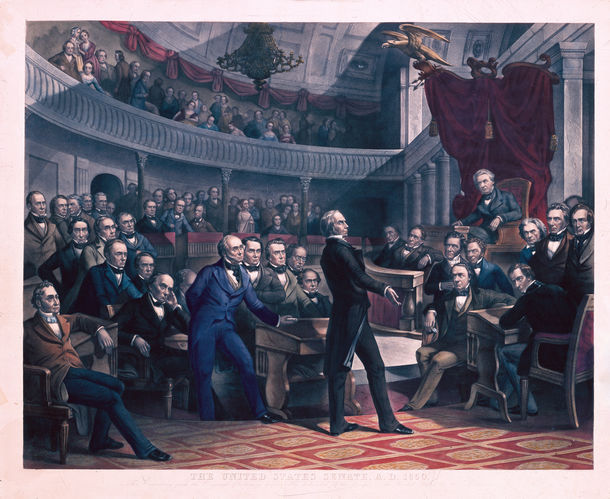
The Compromise of 1850
Five Measures, One Temporary Settlement
The territory acquired from Mexico reopened the question of whether slavery would expand westward. California sought admission as a free state, Texas claimed land held by New Mexico, and Southern leaders warned that the changing balance threatened their political security.
After Henry Clay’s omnibus bill failed, Senator Stephen Douglas divided the plan into separate measures. Fillmore supported the individual bills and signed them into law.
California
Admitted to the Union as a free state.
Utah and New Mexico
Organized as territories without a federal prohibition on slavery.
Texas Boundary
Texas accepted a smaller boundary in exchange for $10 million.
District of Columbia
The slave trade—but not slavery itself—was abolished in the nation’s capital.
Fugitive Slave Act
Federal enforcement against people escaping slavery was greatly strengthened.
Political Result
The immediate secession crisis eased, but sectional distrust deepened.
The Fugitive Slave Act
The Moral Failure at the Center of His Presidency
The act created federal procedures for the arrest and return of people accused of escaping slavery. Alleged fugitives could not demand a jury trial and were restricted from testifying in their own defense. Federal commissioners received different fees depending on whether they ordered release or return, creating an appearance of financial bias.
Citizens who helped fugitives could face fines and imprisonment. Federal officials could compel bystanders to assist in captures. Free Black Americans also faced the danger of kidnapping and wrongful removal.
Rather than settle the slavery question, enforcement brought its violence into Northern cities. Resistance grew, personal-liberty laws multiplied, and abolitionism gained new urgency.
The moral judgment: Fillmore preserved a political arrangement by enforcing a law that subordinated human freedom to slaveholders’ claims. Temporary peace purchased through the capture of vulnerable people was neither just nor durable.
War & Foreign Policy
Restraint in Cuba, Initiative in the Pacific
Japan Expedition
Fillmore authorized Commodore Matthew Perry’s mission to seek protection for shipwrecked sailors, access to ports, and commercial relations. Perry arrived after Fillmore left office.
Cuban Filibusters
He enforced neutrality laws against private expeditions seeking to seize Spanish Cuba, resisting pressure from expansionists and slaveholding interests.
Hawaiian Independence
His administration warned European powers against attempts to annex Hawaii, asserting a growing American strategic interest in the Pacific.
Central America
Fillmore continued efforts to manage competition with Britain following the Clayton–Bulwer Treaty negotiated under Taylor.
Faith & Character
Self-Improvement, Civic Duty, and Moral Compromise
Rise Through Education
Born into poverty with little schooling, Fillmore educated himself, entered law, and treated learning as a path toward personal and civic improvement.
Unitarian Faith
Fillmore was associated with Unitarian Christianity, emphasizing moral conduct, reason, and public service rather than doctrinal confrontation.
Institution Builder
He helped establish institutions in Buffalo, including the organization that became the University at Buffalo, and supported libraries and civic development.
Compromise Without Justice
His instinct for moderation became a grave weakness when maintaining political order required participation in the coercion of people fleeing slavery.
The Collapse of the Whigs
A Party the Slavery Question Destroyed
Fillmore sought the Whig nomination in 1852, but Northern Whigs opposed him because of the Fugitive Slave Act. The party nominated General Winfield Scott and then suffered a devastating national defeat.
In 1856, Fillmore ran again with the American Party, commonly called the Know-Nothing Party. The movement drew support from hostility toward Catholic immigrants as well as former Whigs seeking an alternative to Democrats and Republicans.
Fillmore attempted to emphasize national unity, but his acceptance of a nativist nomination damaged his legacy. He carried only Maryland and never returned to national office.
The political lesson: The Whigs collapsed because procedural compromise could no longer bridge the moral and sectional division over slavery. Fillmore’s later alliance with a nativist movement showed the danger of rebuilding political coalitions through fear of outsiders.
Presidential Scorecard
Fillmore’s Record
Order-Centered
Emphasized lawful enforcement but gave insufficient weight to the denial of due process under the Fugitive Slave Act.
Conventional
Accepted congressional leadership while using executive authority to enforce the compromise settlement.
Stable but Limited
Presided during relative prosperity without leaving a transformative economic program.
Forward-Looking
Resisted unlawful expansion in Cuba and initiated the diplomatic opening to Japan.
Temporary Success
Helped avert an immediate crisis but could not preserve the Whig coalition or build lasting sectional trust.
Severely Damaged
Enforcement of the Fugitive Slave Act remains the defining moral failure of his presidency.
Lasting Legacy
The President Who Chose Union Through Compromise
Fillmore believed the Compromise of 1850 preserved the Union at a moment of extraordinary danger. In the short term, it did reduce secessionist pressure and resolve several territorial disputes.
But the settlement did not remove the underlying conflict. The Fugitive Slave Act nationalized the enforcement of slavery, radicalized many Northerners, endangered free Black Americans, and revealed that political moderation could become complicity with injustice.
Final assessment
Millard Fillmore achieved temporary political peace at an unacceptable human cost. His rise through education, administrative competence, and measured foreign policy deserve recognition. Yet his enforcement of the Fugitive Slave Act and later acceptance of a nativist nomination prevent a favorable final judgment. He postponed disunion without addressing the evil driving it.
Sources & Further Reading
Trace the Evidence
- Miller Center: Millard Fillmore
- White House Historical Association: Millard Fillmore
- Library of Congress: Millard Fillmore Resource Guide
- National Archives: Compromise of 1850
- United States Senate: Clay Presents the Compromise
- Office of the Historian: Opening to Japan
- Library of Congress: Fugitive Slave Act