11th President • 1845–1849
James K. Polk
The disciplined one-term president fulfilled nearly every major promise he made, secured the Oregon boundary, completed the annexation of Texas, defeated Mexico, and extended the United States to the Pacific. His success created a continental republic—and intensified the struggle over slavery that threatened to tear it apart.

Why He Matters
The President Who Made America Continental
Polk entered office with a defined program and completed it with uncommon discipline. Yet the territory he acquired reopened the nation’s most dangerous moral and constitutional dispute.
A Continental Nation
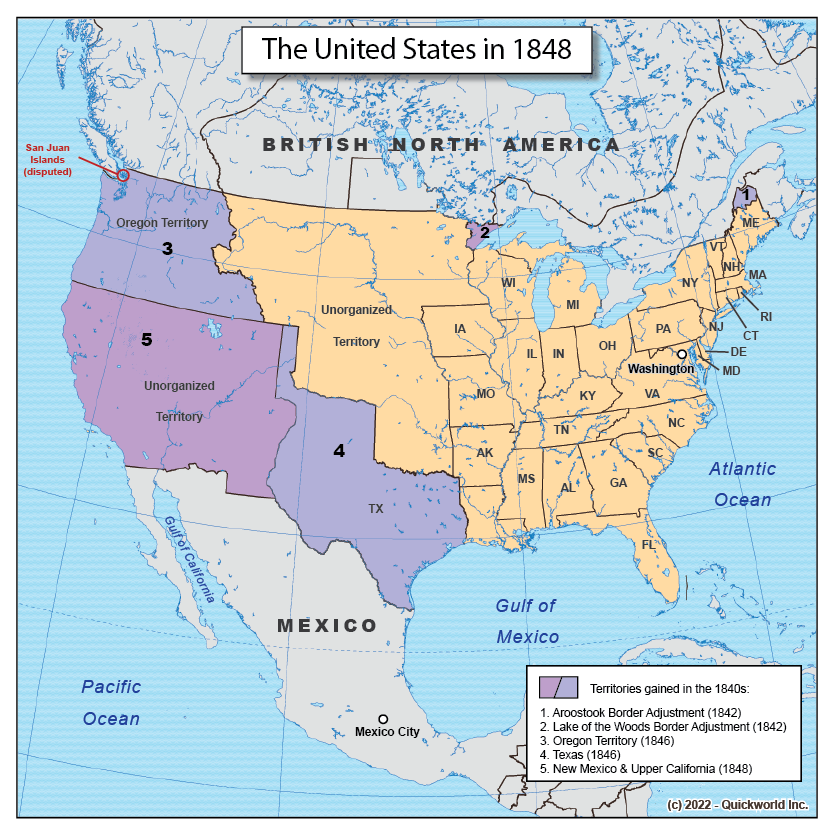
Under Polk, the United States secured the Pacific Northwest and acquired California and the Southwest, establishing its modern continental reach.
Promises Fulfilled
He lowered tariffs, restored the Independent Treasury, settled Oregon, and acquired western territory—all during the single term he promised to serve.
War and Executive Power
Polk’s deployment of troops into disputed territory helped produce war with Mexico and raised lasting questions about a president’s ability to lead Congress toward conflict.
The Slavery Crisis
Every western acquisition forced the republic to ask whether slavery would expand. Territorial victory accelerated sectional division.
The Road to the Presidency
Young Hickory and the Dark-Horse Victory
Polk represented Tennessee in the House, became Andrew Jackson’s reliable ally, and served as speaker from 1835 to 1839.
He won election as governor of Tennessee but lost reelection contests in 1841 and 1843.
After leading Democrats deadlocked, Polk emerged as the first successful dark-horse presidential nominee.
Running on territorial expansion and the reannexation of Texas, he narrowly defeated Whig statesman Henry Clay.
At age 49, Polk became the youngest president inaugurated to that point and entered office committed to serving one term.

Defining Decisions
Six Tests of Polk’s Leadership
Completing Texas Annexation
John Tyler initiated annexation by joint resolution; Polk oversaw its completion. Texas entered the Union in December 1845 amid an unresolved border dispute with Mexico.
Settling the Oregon Boundary
The Oregon Treaty divided the region at the 49th parallel. Polk gained the Pacific Northwest without risking a second war with Britain.
Going to War With Mexico
After Mexican forces attacked American troops in disputed territory, Polk declared that Mexico had shed American blood on American soil. Congress approved war.
Signing the Walker Tariff
The law reduced protective duties and reflected Democratic support for lower tariffs and expanded international commerce.
Restoring the Independent Treasury
Federal money was again separated from private banks, completing a central objective of Jacksonian economic policy.
Accepting the Mexican Cession
The Treaty of Guadalupe Hidalgo brought California and the Southwest under American control in exchange for $15 million and other obligations.

Constitution & Power
Congress Declared the War—but Polk Shaped the Choice
Polk worked through constitutional forms while using presidential control of diplomacy, troop movements, and information to direct national policy.
Congress possessed the power to declare war and formally exercised it in 1846. Before that vote, however, Polk ordered General Zachary Taylor into the disputed land between the Nueces River and Rio Grande. The resulting clash allowed the president to present Congress with an armed conflict already underway.
“Mexico has passed the boundary of the United States, has invaded our territory and shed American blood upon the American soil.”James K. Polk • War Message to Congress, May 11, 1846
The constitutional tension: A president can influence Congress’s war decision without formally usurping its declaration power. Polk’s actions show how military deployments may create circumstances in which legislators face pressure to approve a conflict after hostilities begin.
War With Mexico
Victory, Territory, and a Contested Beginning
Mexico had never accepted the independence or annexation of Texas. Texas and the United States claimed the Rio Grande as the boundary, while Mexico treated the Nueces River farther north as the limit of Texas. Polk also wanted California and New Mexico, but Mexico rejected American efforts to purchase them.
After fighting began in April 1846, American armies won campaigns across northern Mexico and California. General Winfield Scott landed at Veracruz and marched to Mexico City. The Treaty of Guadalupe Hidalgo ended the war in 1848.
Whig critics did not necessarily refuse supplies to American troops, but they challenged Polk’s account of the war’s origin. Congressman Abraham Lincoln’s “Spot Resolutions” demanded that Polk identify the precise spot where blood had been shed and prove it belonged to the United States.
The governing verdict
Polk achieved his territorial objective with remarkable military and political effectiveness. Whether he maneuvered the country into an avoidable war remains the central controversy of his presidency.
Expansion & Slavery
The Land That Destabilized the Union
The Mexican Cession included present-day California, Nevada, Utah, and parts of Arizona, New Mexico, Colorado, and Wyoming. It secured Pacific ports and opened immense territory to settlement and commerce.
But acquisition immediately raised the question of slavery. Representative David Wilmot proposed banning slavery from land obtained from Mexico. The Wilmot Proviso repeatedly passed the House but failed in the Senate, exposing a widening sectional divide.
Polk favored extending the Missouri Compromise line west to the Pacific, but neither North nor South accepted that as a lasting settlement. The dispute flowed into the Compromise of 1850 and the crises that preceded the Civil War.
The moral judgment: Territorial expansion increased American power without extending liberty equally. Polk enlarged a republic that continued to enslave human beings, and the new land made that contradiction impossible to contain.
Economy & Administration
A Focused Program Completed in Four Years
The Walker Tariff
Polk reduced tariff rates, believing lower duties would encourage trade and prevent concentrated industrial interests from receiving excessive federal protection.
The Independent Treasury
The government again held its funds outside private banks, reflecting Democratic suspicion of concentrated financial power.
Administrative Discipline
Polk worked long hours, closely supervised his cabinet, and treated the presidency as an instrument for completing a fixed program.
Internal Improvements
He vetoed a rivers-and-harbors bill, arguing that locally concentrated projects could exceed federal authority and encourage political favoritism.
Faith & Character
Duty, Discipline, and Moral Complexity
Christian Formation
Raised in a Presbyterian household, Polk regularly attended worship. Near death, he received Methodist baptism from the minister who had married him and Sarah Childress Polk.
Unusual Self-Discipline
Polk was serious, methodical, and relentless. He promised one term, pursued a defined agenda, and declined to seek reelection after completing it.
Slaveholding
Polk owned enslaved people and acquired additional enslaved laborers while president. His personal prosperity and political world were tied to an institution that contradicted the nation’s claims of liberty.
The Limits of Effectiveness
His character demonstrates that diligence and promise-keeping are not sufficient measures of justice. A disciplined leader can efficiently pursue policies carrying grave human costs.
Presidential Scorecard
Polk’s Record
Formally Lawful, Seriously Tested
Congress declared war, but Polk’s prior troop deployment shaped the circumstances of its decision.
Energetic
He directed diplomacy, military policy, and administration with tight personal control.
Programmatic
Lower tariffs and the Independent Treasury fulfilled major Democratic commitments.
Transformative
He settled Oregon peacefully and used victory over Mexico to establish a continental nation.
Highly Effective
Few presidents have completed so much of a stated program in a single term.
Deeply Divided
Expansion strengthened the country but came through war, slaveholding, and intensified sectional conflict.
Lasting Legacy
The Successful President Whose Success Carried a Price
Polk left office having achieved nearly every major objective he set. The United States possessed secure claims to the Pacific Northwest, California, and the Southwest. Its economic system reflected Democratic priorities, and its continental future appeared assured.
He also left the nation confronting a conflict its leaders could not permanently settle. The territory obtained from Mexico upset the balance between free and slave states and transformed slavery’s expansion into the central political question of the age.
Polk kept his one-term promise and departed in March 1849. Exhausted and ill, he died only 103 days later at age 53—the shortest retirement of any former president.
Final assessment
James K. Polk was one of America’s most effective presidents, but his effectiveness cannot be separated from the consequences of what he achieved. He made the United States continental, strengthened its strategic position, and kept his political promises. He also led the nation into a disputed war and accelerated the slavery crisis that would culminate in civil war.
Sources & Further Reading
Trace the Evidence
- Miller Center: James K. Polk
- White House Historical Association: James K. Polk
- Library of Congress: James K. Polk Resource Guide
- Office of the Historian: Texas Annexation
- Office of the Historian: Oregon Territory
- Office of the Historian: The Mexican–American War
- National Archives: Treaty of Guadalupe Hidalgo
- United States Senate: George M. Dallas