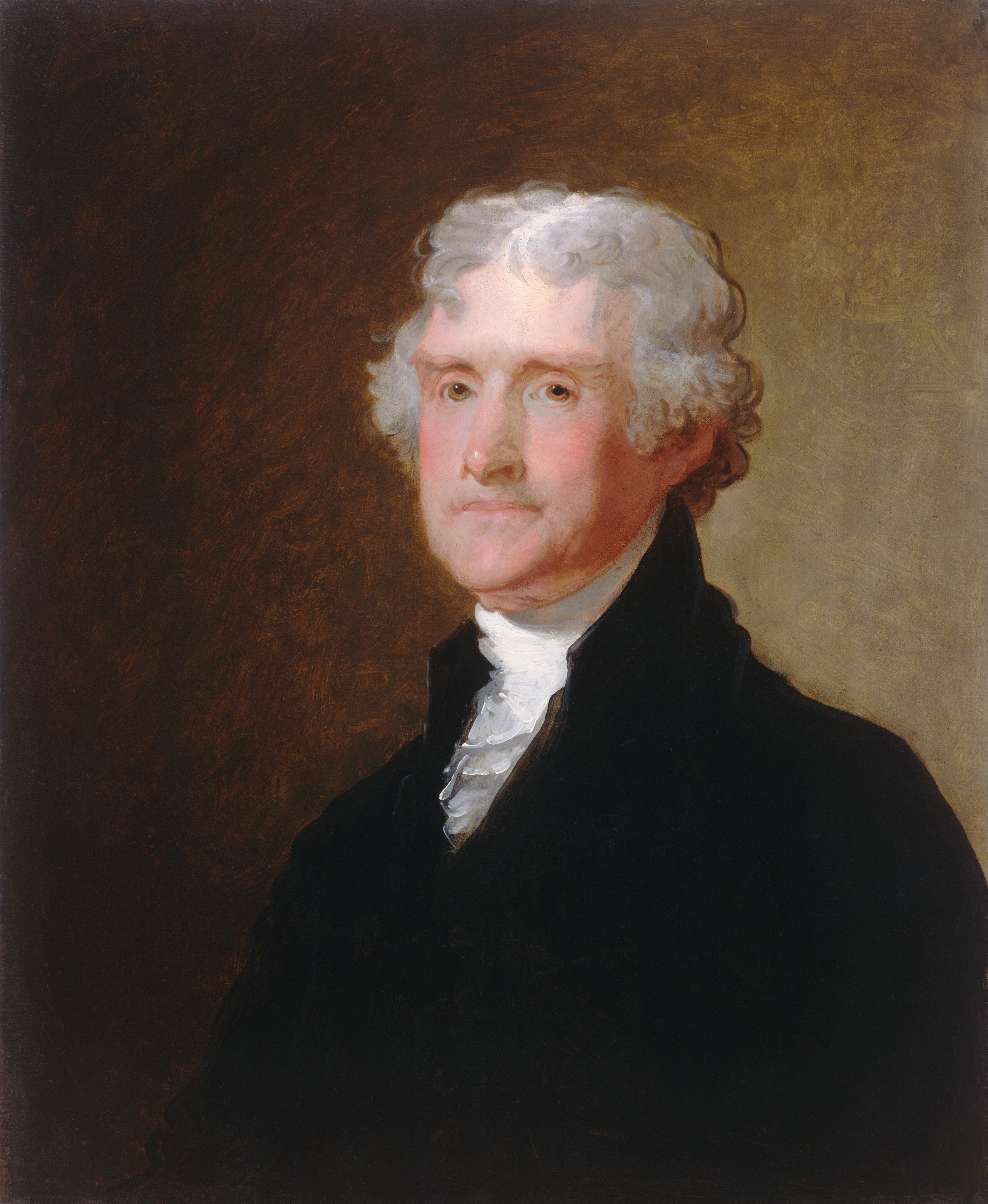
3rd President • 1801–1809
Thomas Jefferson
The author of America’s creed of equality entered office promising limited government. His presidency reduced parts of the federal establishment, doubled the nation’s territory, confronted piracy overseas—and revealed profound contradictions between principle and power.
Why He Matters
The President of Principle—and Contradiction
Jefferson supplied some of the republic’s most enduring language about natural rights and limited government. His administration then demonstrated how quickly opportunity, danger, and national ambition can test those principles.
Author of the Declaration
Jefferson gave the Revolution its most enduring statement: legitimate government rests on human equality, natural rights, and the consent of the governed. Those words became a standard later generations used to challenge slavery, segregation, and unequal citizenship.
Champion of Religious Liberty
His Virginia Statute for Religious Freedom rejected compelled worship and religious tests for civil rights. Jefferson regarded freedom of conscience as a natural right beyond the proper reach of government.
Architect of Continental Expansion
The Louisiana Purchase doubled the nation’s territory and secured the Mississippi River system. It also accelerated expansion into lands inhabited by Indigenous nations and intensified the future struggle over slavery in the West.
Founder of a Political Tradition
Jefferson’s emphasis on decentralized authority, agricultural independence, civil liberties, economical government, and suspicion of concentrated power shaped American politics long after his party disappeared.
The Road to the Presidency
Revolutionary, Diplomat, Party Leader
At thirty-three, Jefferson drafted the Declaration of Independence for the Committee of Five, transforming colonial resistance into a universal argument about rights and legitimate government.
As governor of Virginia during wartime invasion, he struggled to mobilize the state and faced criticism after leaving Richmond ahead of British forces.
As minister to France, Jefferson observed European monarchy and revolution while representing American interests abroad.
As Washington’s secretary of state, he opposed Hamilton’s financial program and developed a narrower reading of federal power.
Jefferson served as vice president under John Adams while emerging as leader of the Democratic-Republican opposition.
The House decided the tied election of 1800 after thirty-six ballots. The peaceful transfer from Federalists to Democratic-Republicans became known as the “Revolution of 1800.”

Defining Decisions
Six Tests of Jefferson’s Leadership
Reducing the Federal Establishment
Jefferson pursued lower internal taxes, military reductions, restrained spending, and debt reduction. His administration allowed the Alien and Sedition Acts to expire and pardoned people convicted under the Sedition Act.
Fighting the First Barbary War
When Tripoli demanded greater tribute and declared war, Jefferson sent naval forces to the Mediterranean. He acted quickly but sought congressional support for sustained military operations, creating an early test of divided war powers.
Completing the Louisiana Purchase
Jefferson doubted that the Constitution expressly authorized territorial acquisition and considered an amendment. Fearing that delay could lose the opportunity, he accepted the treaty process instead. The decision was strategically brilliant but difficult to reconcile with his strict-construction principles.
Commissioning Lewis and Clark
The expedition mapped western geography, gathered scientific information, pursued trade, and asserted American claims. It also advanced a federal vision of expansion that would place growing pressure on Native lands and sovereignty.
Ending Legal Importation of Enslaved People
Jefferson signed legislation prohibiting the international slave trade beginning in 1808, the earliest date the Constitution permitted Congress to impose the ban. Illegal trafficking and domestic slavery continued.
Imposing the Embargo
To avoid war and pressure Britain and France, Jefferson supported a sweeping halt to American overseas trade. The policy damaged American merchants and farmers, encouraged smuggling, and required intrusive federal enforcement before being repealed near the end of his term.


Constitution & Power
Strict Construction Meets Presidential Opportunity
Jefferson came to office warning against concentrated federal power, yet his greatest achievement depended on powers he once doubted.
The Louisiana Purchase illustrates the permanent tension between constitutional theory and executive responsibility. Jefferson initially believed an amendment was necessary, but he ultimately relied on the president’s treaty-making role and Senate ratification. The Embargo revealed the opposite danger: a policy intended to avoid war expanded federal control over ordinary commerce and demanded aggressive enforcement. Jefferson reduced some powers while enlarging others.
Faith & Character
Religious Liberty and a Private Theology
“The Mind Free”
Jefferson opposed government coercion in matters of faith. His statute protected belief and unbelief alike, and his 1802 letter to the Danbury Baptists described a “wall of separation between Church and State.” He attended religious services held in the Capitol while maintaining that federal power could not direct religious doctrine or worship.
Christian Ethics Without Christian Orthodoxy
Jefferson admired the moral teachings of Jesus but rejected central doctrines of historic Christianity, including the Trinity and miracles. He created edited Gospel compilations that removed supernatural passages. He should therefore be described neither simply as an orthodox Christian nor casually as an atheist.
“Almighty God hath created the mind free.”Thomas Jefferson • Virginia Statute for Religious Freedom

The Central Contradiction
Equality, Slavery, and Sally Hemings
No evaluation of Jefferson is honest if it celebrates the Declaration while treating the lives of those he enslaved as a footnote.
Jefferson enslaved more than six hundred people over his lifetime and depended economically on their labor. He wrote forcefully about the injustice and danger of slavery but did not free most of the people he held in bondage. His policies and vision of western expansion also left open—and enlarged—the national struggle over whether slavery would spread.
The Thomas Jefferson Foundation at Monticello regards Jefferson’s paternity of Sally Hemings’s children as a settled historical matter. Hemings was enslaved by Jefferson, and the profound imbalance of legal and personal power must remain central to any account of their connection. Four of their children survived to adulthood and were eventually allowed to leave or were freed.
Jefferson signed the 1807 law ending legal participation in the international slave trade, but he did not use the presidency to pursue emancipation. His words helped supply the moral vocabulary of abolition; his conduct showed how readily a person can condemn an institution in theory while continuing to benefit from it.

Historical judgment requires both truths: Jefferson articulated a principle of human equality that transformed the world, and he denied that equality to people whose labor sustained his life. The power of the principle does not erase the hypocrisy; the hypocrisy does not make the principle untrue.
Presidential Scorecard
Jefferson’s Record
Principled but Flexible
Advocated limited federal power, then accepted broader authority when Louisiana became available.
Selective Expansion
Reduced parts of government while enlarging presidential initiative in diplomacy, territory, war, and trade enforcement.
Early Restraint, Late Failure
Reduced taxes and debt early; the Embargo later inflicted heavy economic damage.
Expansion and Independence
Secured Louisiana and resisted tribute, but failed to protect neutral trade through economic coercion.
Enduring Advocate
Advanced natural rights, religious freedom, and freedom from the Sedition Act.
Slavery
His lifelong slaveholding and conduct toward the Hemings family contradicted his declaration of equality.
Lasting Legacy
The Nation Still Lives Inside Jefferson’s Contradictions
Jefferson enlarged the physical republic while giving it an enduring philosophy of rights and popular government. The Declaration, the Virginia Statute for Religious Freedom, the Louisiana Purchase, and the University of Virginia ensured his permanent place in American history.
His presidency also warns against evaluating leaders only by their stated philosophy. The strict constructionist purchased an empire; the opponent of concentrated power enforced a sweeping embargo; the author of equality enslaved hundreds. Jefferson’s ideas gave later Americans tools to demand greater freedom, even when his own life failed to honor their full meaning.
Final assessment
Thomas Jefferson expanded America’s territory and its language of liberty, but he never resolved the conflict between them. His achievements were foundational, his constitutional flexibility consequential, and his moral contradictions inseparable from his legacy.
Sources & Further Reading