The Presidents of the United States
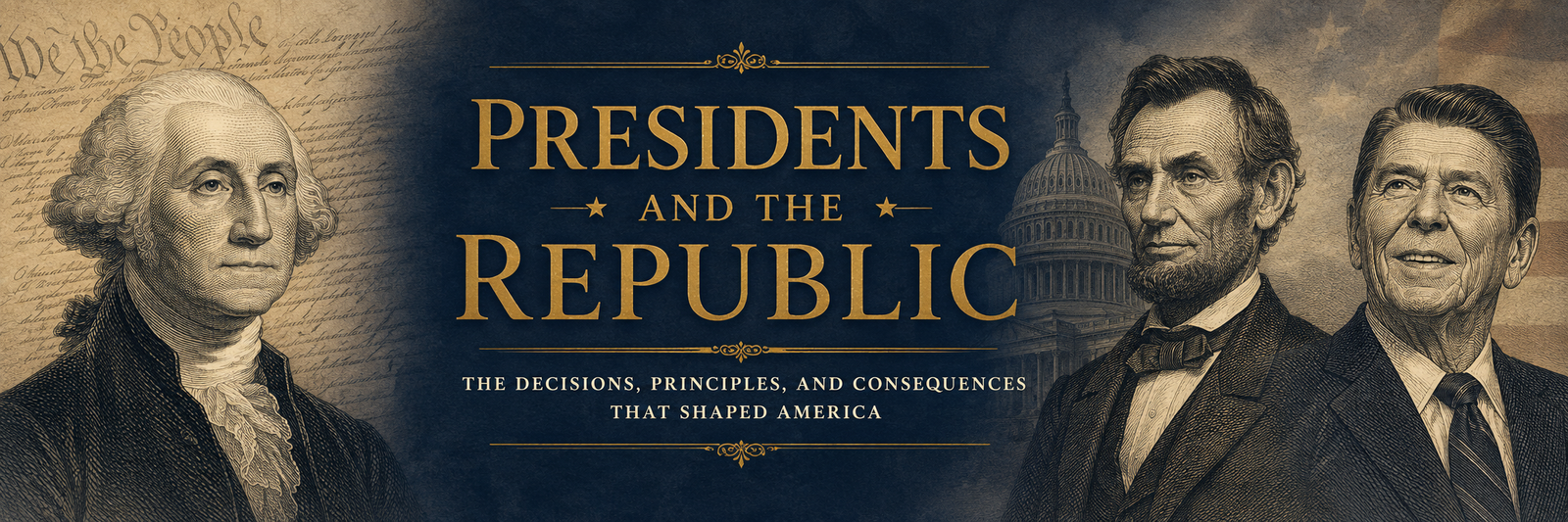
1789 to the Present
The Presidents of the United States
Explore every presidency through the decisions, convictions, conflicts, and consequences that shaped the American republic. Each profile examines not only what a president accomplished, but how he used the office entrusted to him.
One Republic
Jump to an era
Featured Presidential Profiles
1789–1797
George Washington
Establishing the presidency, defining restraint, and creating precedents for every successor.
Explore Washington →1861–1865
Abraham Lincoln
Union, emancipation, civil war, and the enduring debate over emergency presidential power.
Explore Lincoln →1933–1945
Franklin D. Roosevelt
The New Deal, global war, and a lasting transformation of federal and executive power.
Explore Roosevelt →1981–1989
Ronald Reagan
Conservative renewal, economic change, Cold War strategy, and a transformed Republican Party.
Explore Reagan →1789–1829
Founding the Presidency
The first presidents turned a brief constitutional framework into a functioning executive office while the young republic searched for its political identity.
George Washington
Established the customs, authority, and voluntary limits of the new presidency.
Read profile →John Adams
Defended national authority amid foreign crisis and bitter partisan conflict.
Profile coming soonThomas Jefferson
Reduced parts of the federal state while stretching presidential power through expansion.
Profile coming soonJames Madison
A principal architect of the Constitution tested by the demands of wartime leadership.
Profile coming soonJames Monroe
Presided over national growth, one-party government, and a defining foreign-policy doctrine.
Profile coming soonJohn Quincy Adams
Advanced an ambitious national program but struggled against an emerging popular opposition.
Profile coming soon1829–1861
Expansion and Sectional Crisis
Popular democracy and continental expansion enlarged presidential influence while slavery and sectional division pushed the Union toward rupture.
Andrew Jackson
Recast the presidency as the direct voice of the people and greatly expanded its political force.
Profile coming soonMartin Van Buren
Built the modern party system and confronted a severe national financial panic.
Profile coming soonWilliam Henry Harrison
The shortest presidency raised immediate questions about succession and continuity.
Profile coming soonJohn Tyler
Established that a vice president fully assumes the presidency after a president’s death.
Profile coming soonJames K. Polk
Achieved sweeping territorial expansion during a disciplined single-term presidency.
Profile coming soonZachary Taylor
A military hero whose brief presidency confronted the spread of slavery westward.
Profile coming soonMillard Fillmore
Backed the Compromise of 1850 in an unsuccessful effort to quiet sectional conflict.
Profile coming soonFranklin Pierce
His administration’s expansionist policies deepened the national slavery crisis.
Profile coming soonJames Buchanan
Failed to arrest the sectional collapse that culminated in secession.
Profile coming soon1861–1877
Civil War and Reconstruction
Civil war, emancipation, reunion, and constitutional reconstruction permanently altered both the nation and the presidency.
Abraham Lincoln
Preserved the Union, issued emancipation, and exercised extraordinary wartime authority.
Read profile →Andrew Johnson
Clashed with Congress over Reconstruction and became the first president impeached.
Profile coming soonUlysses S. Grant
Used federal authority to defend Reconstruction and the civil rights of freed Americans.
Profile coming soon1877–1921
Industry and Progressive Reform
Industrial power, immigration, reform movements, and overseas expansion reshaped American life and revived presidential leadership.
Rutherford B. Hayes
Entered office after a disputed election and oversaw the end of Reconstruction.
Profile coming soonJames A. Garfield
His assassination intensified the movement to reform federal employment.
Profile coming soonChester A. Arthur
Surprised former allies by championing professional civil-service reform.
Profile coming soonGrover Cleveland
The first president elected to two nonconsecutive terms emphasized limited government.
Profile coming soonBenjamin Harrison
Oversaw major economic legislation and the admission of six western states.
Profile coming soonWilliam McKinley
Led the nation through war with Spain and the emergence of overseas power.
Profile coming soonTheodore Roosevelt
Made the presidency a forceful center of reform, conservation, and global influence.
Profile coming soonWilliam Howard Taft
Pursued trust enforcement while taking a more restrained view of executive authority.
Profile coming soonWoodrow Wilson
Expanded federal administration and led the nation through the First World War.
Profile coming soon1921–1945
Depression and World War
Boom, collapse, depression, and global war produced the most dramatic peacetime and wartime expansion of federal power in American history.
Warren G. Harding
Promised a return to normalcy after war, but scandals damaged his administration’s legacy.
Profile coming soonCalvin Coolidge
Championed economy in government, lower taxes, and restrained presidential leadership.
Profile coming soonHerbert Hoover
Confronted the Great Depression with measures judged insufficient by a suffering nation.
Profile coming soonFranklin D. Roosevelt
Transformed domestic government and executive leadership through depression and world war.
Read profile →1945–1981
Cold War America
Nuclear rivalry, civil rights, Korea, Vietnam, and domestic upheaval placed the modern presidency at the center of American government.
Harry S. Truman
Made momentous decisions at the end of World War II and the beginning of the Cold War.
Profile coming soonDwight D. Eisenhower
Balanced Cold War commitments, fiscal restraint, and major national infrastructure.
Profile coming soonJohn F. Kennedy
Confronted nuclear crisis and inspired a generation before his assassination.
Profile coming soonLyndon B. Johnson
Enacted civil-rights and Great Society laws while escalating the Vietnam War.
Profile coming soonRichard Nixon
Reshaped foreign policy but resigned after abuses of presidential power in Watergate.
Profile coming soonGerald Ford
Worked to restore trust in government after Watergate and the Nixon pardon.
Profile coming soonJimmy Carter
Emphasized human rights while facing inflation, energy shortages, and foreign crisis.
Profile coming soon1981–2001
Conservative Renewal
A conservative political realignment, the end of the Cold War, and globalization defined the final decades of the twentieth century.
Ronald Reagan
Revived modern conservatism and pursued victory in the closing phase of the Cold War.
Read profile →George H. W. Bush
Managed the Cold War’s end and led an international coalition in the Persian Gulf.
Profile coming soonBill Clinton
Presided over economic growth, divided government, and the second presidential impeachment.
Profile coming soon2001–Present
The Modern Presidency
Terrorism, prolonged war, financial crisis, polarization, pandemic, and new technology have tested constitutional government in the twenty-first century.
George W. Bush
Led the nation after September 11 and greatly expanded national-security power.
Profile coming soonBarack Obama
Responded to financial crisis and enacted a major expansion of federal health policy.
Profile coming soonDonald Trump
Reshaped the Republican Party and became the second president elected to nonconsecutive terms.
Profile coming soonJoe Biden
Governed through pandemic recovery, inflation, major spending laws, and renewed great-power rivalry.
Profile coming soonWhy 47 presidencies but 45 people? Grover Cleveland and Donald Trump each served two nonconsecutive terms and therefore hold two numbers in the official sequence.
Explore Presidents by Theme
Power
Presidents Who Expanded Executive Power
Examine the crises, precedents, and ambitions that enlarged the office.
Economy
Presidents Who Reduced the National Debt
Compare the administrations that left the nation owing less than before.
Character
Presidents and Religious Faith
Distinguish public language, private belief, and documented religious practice.
Legacy
Greatest Presidential Successes and Failures
Judge leadership by constitutional principle and measurable consequence.