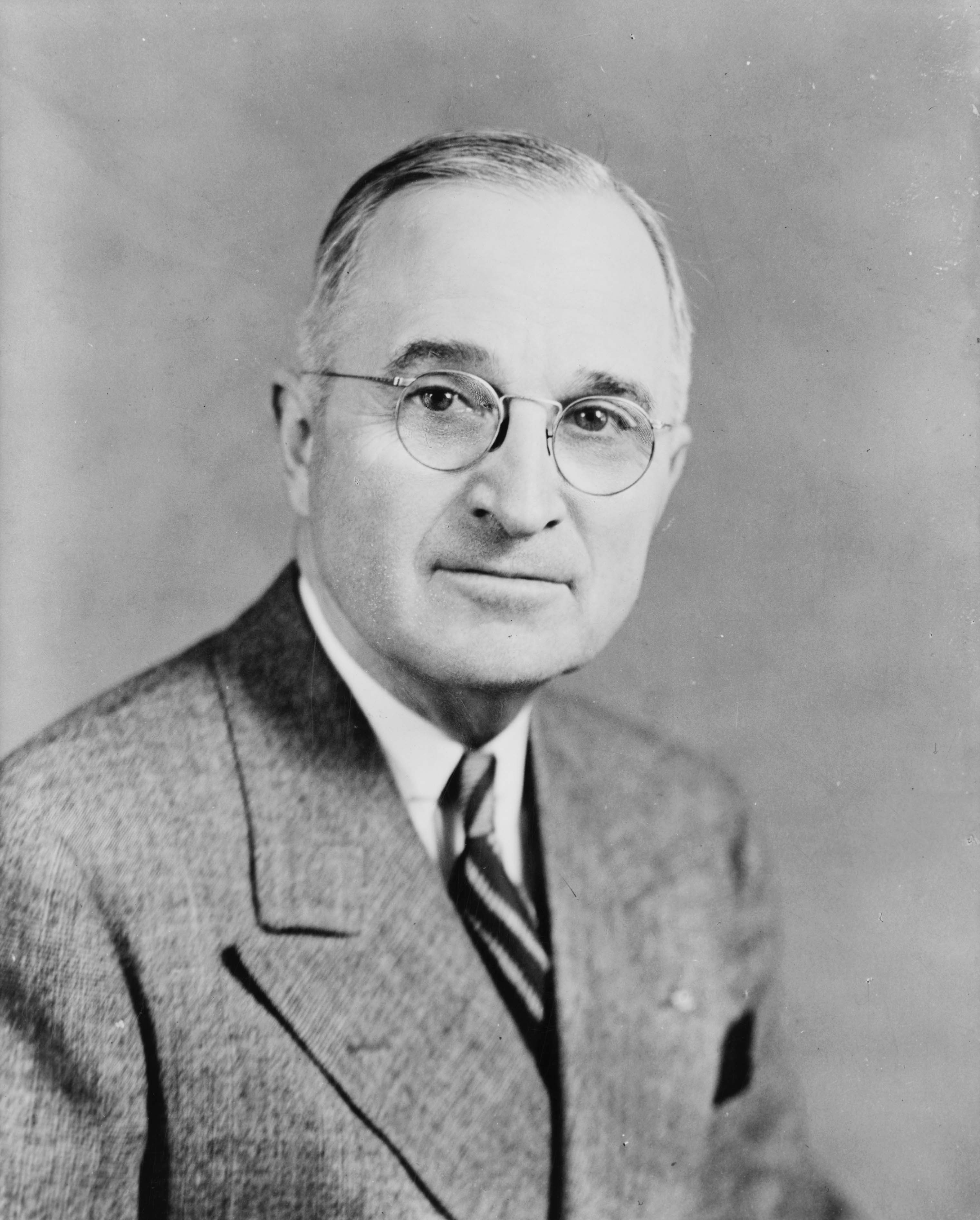
33rd President • 1945–1953
Harry S. Truman
Truman inherited the presidency in the final months of World War II and helped define America’s role in the Cold War. His record joins the atomic bomb decision, European recovery, military desegregation, and the Korean War with a lasting test of presidential power.

Why He Matters
The President Who Faced the Burdens of Victory
The Atomic Age
Truman presided over the first use of nuclear weapons in war, a decision with enduring strategic and moral consequences.
Containing Soviet Power
His administration helped establish the aid programs and alliances that became central to American Cold War policy.
Military Desegregation
His order requiring equality in the armed services became a major federal commitment to racial justice.
Constitutional Accountability
His presidency illustrates both the importance of civilian military leadership and the limits of emergency executive authority.
The Road to the Presidency
From Missouri to an Unexpected Presidency
Born in Lamar, Missouri, Truman worked in banking and spent more than a decade farming before serving overseas in World War I.
He commanded an artillery battery in France. After returning home, he married Bess Wallace and entered the clothing business.
Following the failure of his store, he built a political career in Jackson County. His county judge position involved administration rather than courtroom judging.
Elected to the U.S. Senate, Truman gained national attention investigating waste and abuses in defense contracting.
He became vice president on January 20. Roosevelt died on April 12, leaving Truman president after just 82 days in the vice presidency.
Defining Decisions
Six Tests of Truman’s Leadership
Using Atomic Weapons
Truman approved atomic bombing as a means of ending the war with Japan, bringing unprecedented destruction to Hiroshima and Nagasaki.
Supporting European Recovery
The Truman Doctrine and Marshall Plan linked American assistance to the defense and reconstruction of countries facing instability.
Holding Firm in Berlin
His administration supported an airlift to supply West Berlin during the Soviet blockade.
Ordering Military Equality
Executive Order 9981 required equality of treatment and opportunity throughout the armed services.
Fighting a Limited War
He committed forces to Korea, then dismissed General Douglas MacArthur amid disagreements over the conflict’s direction.
Seizing the Steel Mills
Truman attempted to prevent a wartime steel strike through federal seizure. The Supreme Court ruled against him.
Constitution & Power
The Steel Seizure and the Limits of Emergency Authority
National necessity did not supply unlimited presidential power.
Truman believed uninterrupted steel production was essential during the Korean War. The dispute turned on whether that need authorized him to take control of private industry without congressional permission.
On April 8, 1952, he ordered the seizure of steel mills to prevent a threatened strike. The companies challenged the action.
In Youngstown Sheet & Tube Co. v. Sawyer, the Supreme Court held that the seizure lacked constitutional or statutory authority. Justice Robert Jackson’s concurrence offered an influential framework for evaluating presidential power according to whether Congress supports, is silent about, or opposes an executive action.
The constitutional judgment: Presidents may face urgent problems, but urgency alone does not authorize them to make law. Truman’s defeat became a landmark boundary on executive power.
Source: Congress: The President’s Powers and Youngstown Framework.
World War II
Hiroshima, Nagasaki, and a Lasting Moral Debate
Truman learned the details of the Manhattan Project after becoming president. The United States dropped atomic bombs on Hiroshima on August 6, 1945, and Nagasaki on August 9. The attacks killed large numbers of civilians and left survivors facing injuries and radiation effects.
Truman and his advisers argued that atomic weapons could end the war quickly and avert the losses of an invasion. Historians continue to debate that reasoning, the alternatives available, and the influence of Soviet entry into the war on Japan’s surrender.
The strategic question and the moral question remain connected: how should leaders weigh the lives they hope to save against the civilians their decisions will kill?
Historical caution: The number of lives an invasion might have cost cannot be known with certainty. Claims that the bomb unquestionably saved a specific number should be treated as estimates, not established facts.
War & Foreign Policy
Building the Early Cold War Order
The Truman Doctrine
Truman requested aid for Greece and Turkey and announced support for peoples resisting coercion. It signaled a broader American commitment to containment.
The Marshall Plan
American economic aid helped European countries rebuild. Recovery was also intended to strengthen political stability in the face of communist influence.
The Berlin Airlift
American and Allied aircraft delivered supplies to West Berlin after the Soviet Union cut surface access. The blockade was lifted in May 1949.
The North Atlantic Alliance
NATO established a collective defense framework linking the United States and Canada with Western European partners.
Source: U.S. Department of State: Truman Doctrine.
Source: U.S. Department of State: Marshall Plan.
Source: Truman Presidential Library: Berlin Airlift.
Source: U.S. Department of State: NATO.
A Changing World
From Potsdam to New International Commitments
At Potsdam in 1945, Truman participated in Allied discussions about defeated Germany and the postwar settlement. Cooperation among wartime partners soon gave way to growing tension with the Soviet Union.
The National Security Act of 1947 reorganized American defense and intelligence, establishing the National Security Council and Central Intelligence Agency and creating a separate Air Force.
In May 1948, Truman recognized Israel’s provisional government shortly after Israel declared independence. The decision became an important milestone in American policy toward the Middle East.
Source: U.S. Department of State: National Security Act.
Source: U.S. Department of State: Creation of Israel.


Civil Rights
Equality in the Armed Services
On July 26, 1948, Truman issued Executive Order 9981, requiring equality of treatment and opportunity in the armed services regardless of race, color, religion, or national origin.
The order did not instantly integrate every unit. Implementation faced resistance, but by the end of the Korean conflict, almost all of the military had been integrated.
Truman’s broader legislative civil-rights agenda encountered opposition in Congress. His military order nevertheless used presidential authority to challenge a major institution of segregation.
An important advance toward equal citizenship
Service to the country should not depend on accepting unequal treatment. Truman’s order helped make that principle a requirement within the armed forces.
Economy
The Fair Deal and the Difficult Return to Peace
After World War II, the economy faced the challenge of shifting from military production to civilian demand. Inflation, shortages, and labor disputes complicated that transition.
Truman’s Fair Deal sought to extend the New Deal through housing, health insurance, stronger social protections, and civil-rights measures. Congress approved a higher minimum wage and housing legislation in 1949 and expanded Social Security in 1950. National health insurance did not pass.
His labor record was also contested. Truman vetoed the Taft-Hartley Act in 1947, but Congress overrode him. He subsequently used some of its provisions to address strikes.
The economic judgment: Truman preserved and extended parts of the New Deal, but congressional resistance kept much of his domestic agenda from becoming law.
Source: Miller Center: Domestic Affairs.
Political Leadership
The Election That Defied Expectations
Many observers expected Republican Thomas E. Dewey to win in 1948. Truman also faced divisions within his own political coalition: segregationist Southern Democrats supported Strom Thurmond, while Henry Wallace ran on the Progressive Party ticket.
Truman campaigned energetically by train, attacking the Republican Congress and appealing to farmers, workers, and urban voters. He won the election with a plurality of the popular vote, and Democrats regained control of Congress.
The mistaken newspaper headline “Dewey Defeats Truman” became the enduring image of his comeback.
The Korean War
Containing Aggression Without a Wider War
North Korea invaded South Korea on June 25, 1950. Truman committed American forces to a United Nations-backed effort to repel the invasion without obtaining a formal congressional declaration of war.
The fighting expanded after Chinese forces intervened. Truman confronted a difficult balance: defend South Korea while avoiding a much wider conflict.
On April 11, 1951, he dismissed General Douglas MacArthur after public disagreements over war policy and escalation. The decision drew fierce criticism but affirmed civilian control over military command.
The unfinished war: Truman left office with fighting still underway. The armistice was signed in July 1953 during Dwight D. Eisenhower’s presidency.
Source: National Archives: U.S. Enters the Korean Conflict.
Source: Truman Presidential Library: Firing MacArthur.
Source: U.S. Department of State: Korean War.
Civil Liberties
Loyalty Investigations and the Fear of Subversion
In 1947, Truman made a federal employee loyalty program permanent amid fears of communist infiltration. Security concerns became entangled with accusations, political pressure, and questions about fairness to the people investigated.
His administration’s approach illustrates a recurring tension: government must address genuine security threats while protecting due process and avoiding judgments based merely on association or unpopular beliefs.
The civil-liberties question: Defending democratic institutions requires evidence and fair procedures. Suspicion must not become a substitute for proof.
Source: Miller Center: Domestic Affairs.
Faith & Character
Responsibility, Conviction, and the Buck That Stopped
A Baptist President
Truman’s religious background was Baptist. His public language connected faith, human dignity, and democratic responsibility.
The Inaugural Bibles
He took the oath with two Bibles, opened to the Beatitudes in Matthew and the Ten Commandments in Exodus.
Accepting Responsibility
His desk sign, “The Buck Stops Here,” expressed the president’s obligation to make decisions rather than shift responsibility.
Accountability Beyond Resolve
Decisiveness is valuable, but a leader remains answerable for the legality, wisdom, and human consequences of each decision.
“The Buck Stops Here” Sign displayed on President Truman’s desk
Source: Miller Center: Harry S. Truman.
Source: Truman Presidential Library: 1949 Inaugural Address.
Presidential Scorecard
Truman’s Record
These assessments are editorial judgments based on the record discussed above.
Tested and Restrained
The steel seizure exceeded presidential authority, while the MacArthur dismissal reinforced civilian control of military policy.
Assertive
Truman used executive action on civil rights and military commitments, producing both significant advances and constitutional controversy.
Selective Progress
The Fair Deal added important protections but fell short of its broader ambitions amid inflation, labor conflict, and congressional resistance.
Foundational
European recovery and collective defense helped shape the Cold War order; Korea exposed the costs of containment.
Resilient
His 1948 victory demonstrated campaign skill and persistence, even though his final years brought deep public dissatisfaction.
Consequential and Contested
Military desegregation stands as a major achievement. Atomic bombing and loyalty investigations remain subjects of serious scrutiny.
After the Presidency
Returning to Independence
Truman left office on January 20, 1953, and returned to Independence, Missouri. He wrote memoirs and remained involved in the development of his presidential library.
He died on December 26, 1972, at age 88. His retirement helped establish a lasting place for research and public education about the presidency.
Lasting Legacy
Responsibility in an Uncertain World
Truman’s presidency helped turn wartime victory into a sustained American role in world affairs. His decisions shaped European recovery, military alliances, nuclear policy, and the federal commitment to civil rights.
His record also reminds us that accepting responsibility is only the beginning. Presidential decisions must remain open to constitutional review and moral judgment.
Final assessment
Harry S. Truman helped build the early Cold War order and advanced equality in the armed forces while confronting some of the presidency’s hardest decisions. His resolve deserves attention, and so do the lives affected by atomic warfare, the burdens of Korea, and the boundaries exposed by his use of executive power.
Sources & Further Reading
Trace the Evidence
- Truman Presidential Library: Biographical Sketch
- Miller Center: Harry S. Truman
- Truman Presidential Library: Atomic Bomb Decision
- U.S. Department of State: Atomic Diplomacy
- U.S. Department of State: Truman Doctrine
- U.S. Department of State: Marshall Plan
- Truman Presidential Library: Berlin Airlift
- U.S. Department of State: NATO
- National Archives: Executive Order 9981
- Congress: Presidential Power and Youngstown
- Miller Center: Domestic Affairs
- Truman Presidential Library: Election of 1948
- Truman Presidential Library: Firing MacArthur
- Truman Presidential Library: 1949 Inaugural Address
- Miller Center: Life After the Presidency