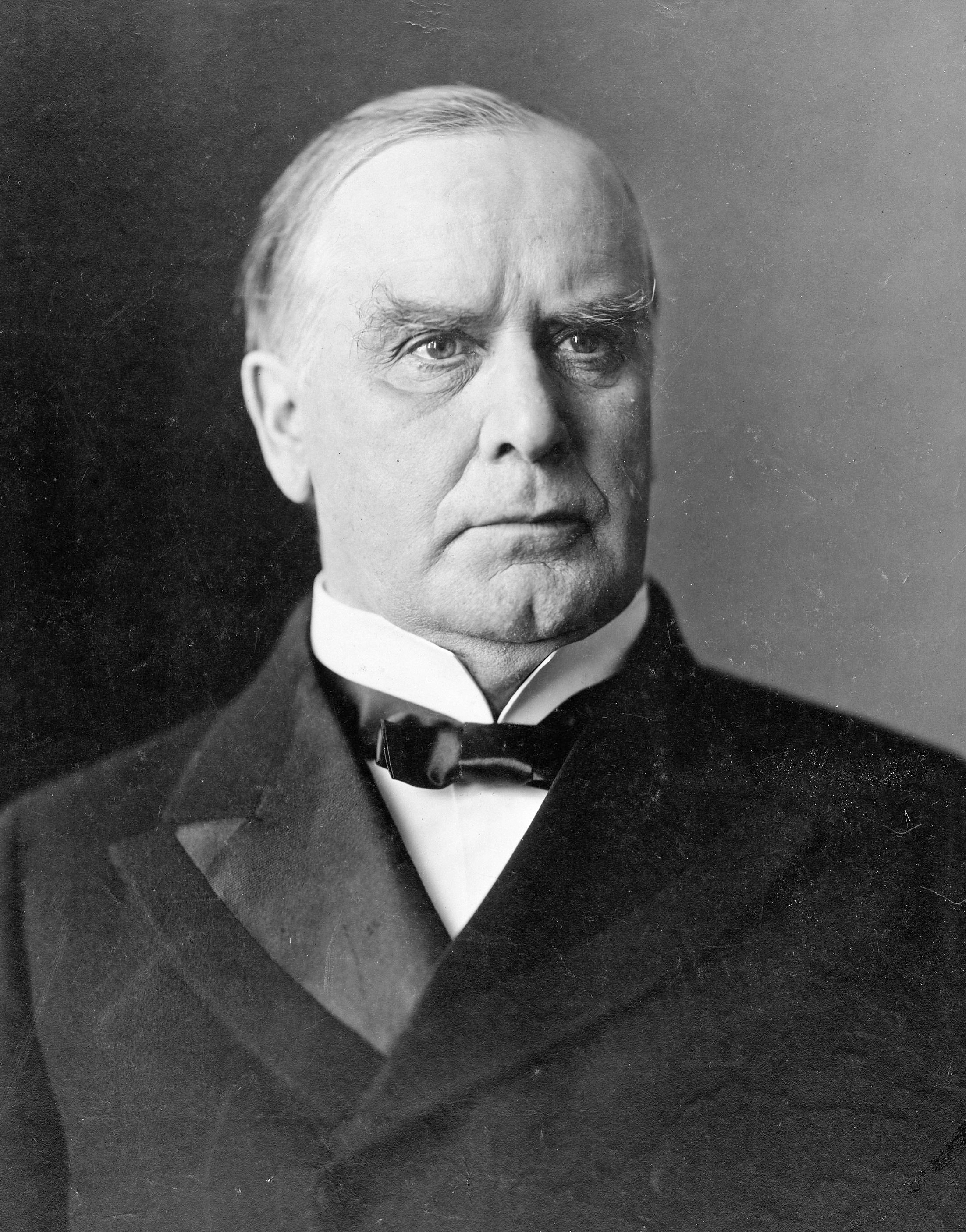
25th President • 1897–1901
William McKinley
McKinley led the United States from depression-era politics into economic recovery and overseas power. His victories brought prosperity and national confidence—but war, annexation, and colonial rule transformed the republic in ways Americans still debate.
After Cleveland’s Second Term
Soldier, Lawyer, and Tariff Republican
McKinley entered the White House as a familiar national politician whose career connected the Civil War generation to modern industrial America.
Born in Niles, Ohio, McKinley enlisted as a private in the Union Army and served with distinction, including at Antietam. He rose to brevet major and became the last president to have served in the Civil War. Afterward he practiced law, served in Congress, and was elected governor of Ohio.
In the House, he became closely identified with protective tariffs. The McKinley Tariff of 1890 sought to shield American industries and wages from foreign competition, but its association with higher consumer prices contributed to Republican defeat that year.
Financial disaster nearly ended his career when he guaranteed a friend’s business debts. Supporters raised money to prevent his bankruptcy, illustrating both his vulnerability and the network of industrialists and party allies surrounding him.
By 1896 the country was suffering through the depression that followed the Panic of 1893. McKinley offered protective tariffs, sound money, and economic stability; Democrat William Jennings Bryan offered free silver and a more populist attack on concentrated wealth.
Election of 1896
Gold, Silver, and a Political Realignment
The Front Porch
McKinley remained in Canton, Ohio, delivering disciplined speeches to visiting delegations. Campaign manager Mark Hanna organized an unprecedented national operation funded heavily by business supporters.
Bryan and Free Silver
Bryan electrified supporters with his “Cross of Gold” speech and traveled widely. He argued that expanding silver coinage would increase the money supply and relieve indebted farmers and workers.
Industry and Urban Voters
McKinley won much of the Northeast and industrial Midwest by presenting the gold standard as security for wages, savings, and commerce. Bryan dominated much of the South and West.
A Republican Era
The victory established a durable Republican advantage in national politics. It also reflected the growing power of cities, industry, national fundraising, advertising, and professionally managed campaigns.
The election of 1896 was more than a contest between two candidates. It was a decision about currency, class, industrialization, and which regions and economic interests would shape the nation’s future.
Economy and Currency
Recovery, Tariffs, and the Gold Standard
McKinley benefited from an economic recovery that restored employment and public confidence after years of depression.
Dingley Tariff
The 1897 law raised protective duties and fulfilled a central Republican promise. McKinley believed tariffs could defend American wages and industry, although critics argued they protected corporations and raised prices.
Gold Standard Act
Signed in 1900, the law formally placed the dollar on a gold basis and committed the Treasury to redeem paper currency in gold. It represented the defeat—at least for that era—of the free-silver movement.
Prosperity Returns
Farm prices, production, employment, and business activity improved. New gold discoveries expanded the money supply, making the gold standard less deflationary than critics had feared.
Corporate Concentration
Large combinations continued consolidating railroads and industries. McKinley’s administration brought some antitrust actions, but it did not challenge concentrated corporate power as aggressively as Theodore Roosevelt later would.
Credit and circumstance
McKinley’s policies reinforced business confidence and monetary stability, but presidents do not control the economy alone. International demand, gold discoveries, investment, and recovery from the earlier collapse were also central to renewed prosperity.
Cuba and the Spanish-American War
A Short War With Enormous Consequences
Cuba’s struggle for independence, Spanish repression, humanitarian concern, sensational journalism, commercial interests, and strategic ambition all pushed the United States toward intervention.
The battleship USS Maine exploded in Havana Harbor, killing 266 American sailors. The cause was uncertain, but public opinion widely blamed Spain.
After failed diplomacy, McKinley asked Congress for authority to intervene. Congress demanded Spain’s withdrawal from Cuba and declared that the United States would not annex the island under the Teller Amendment.
American forces defeated Spanish fleets at Manila Bay and Santiago and fought campaigns in Cuba, Puerto Rico, and the Philippines. The war’s major combat lasted only a few months.
The Treaty of Paris ended the war. Spain relinquished Cuba and ceded Puerto Rico, Guam, and the Philippines to the United States; Washington paid Spain $20 million for the Philippines.
McKinley initially preferred a negotiated solution and resisted immediate war, but he ultimately concluded that Spanish rule in Cuba could not continue. Once war began, his administration pursued objectives extending far beyond Cuban independence.
A Republic Becomes an Overseas Power
Puerto Rico, Guam, Hawaii, and the Philippines
Annexation by Resolution
Congress annexed Hawaii through the Newlands Resolution in 1898. The islands offered strategic value during the Pacific war, but annexation rested on the earlier overthrow of Queen Liliʻuokalani and ignored substantial Native Hawaiian opposition.
Federal Territorial Rule
The Foraker Act of 1900 created a civilian government but left decisive authority in American hands. Puerto Ricans received neither independence nor full constitutional equality.
Independence With Conditions
The United States did not annex Cuba, but the Platt Amendment imposed restrictions on Cuban sovereignty and authorized American intervention. Cuba also leased Guantánamo Bay to the United States.
The Insular Cases
Beginning in 1901, the Supreme Court held that full constitutional protections did not automatically extend to every acquired territory. This created the enduring and controversial doctrine of “unincorporated territories.”
A constitutional turning point
The United States had long expanded across the continent. McKinley’s presidency added a different model: governing distant peoples who lacked equal representation and whose lands were not necessarily expected to become states.
The Philippine-American War
Liberation Becomes Colonial War
Filipino revolutionaries had fought Spain expecting independence. American annexation instead produced a new and far bloodier conflict.
Emilio Aguinaldo’s independence movement had cooperated with American forces against Spain. When the Treaty of Paris transferred the Philippines to the United States without Filipino consent, relations collapsed. Fighting between American and Filipino forces began in February 1899.
McKinley described American rule as “benevolent assimilation,” promising order, education, and eventual self-government. But annexation denied immediate Filipino independence. The conflict became a brutal guerrilla war marked by ambushes, torture, village destruction, detention, disease, and civilian displacement.
Thousands of American and Filipino combatants died, while civilian deaths from warfare, famine, and disease reached into the hundreds of thousands. Organized resistance continued beyond McKinley’s death, and the United States formally declared the war ended in 1902.
The central judgment: Whatever humanitarian language accompanied annexation, Filipinos were not allowed to decide their own political future. The war exposed a contradiction between America’s republican ideals and its exercise of colonial power.
Debating Empire
Expansionists and Anti-Imperialists
Supporters of expansion argued that overseas possessions provided naval bases, commercial access to Asia, national prestige, and an opportunity to spread American institutions and Christianity. Some also expressed openly racial and paternalistic beliefs about America’s right to govern other peoples.
The American Anti-Imperialist League included figures such as Mark Twain, Andrew Carnegie, Jane Addams, and former president Grover Cleveland. They argued that ruling foreign populations without their consent violated the Declaration of Independence and endangered republican government at home.
The central constitutional question was simple but profound: Could a nation founded on government by consent permanently govern people who had never consented to American rule?
China and World Affairs
The Open Door and the Boxer Rebellion
Secretary of State John Hay circulated the Open Door notes, asking major powers to preserve equal commercial access in China rather than divide the country into closed colonial markets. The policy claimed to support China’s territorial integrity while advancing American trade.
During the Boxer Rebellion, McKinley sent American troops as part of an international force that relieved besieged diplomats in Beijing. He acted without a formal declaration of war, illustrating the expanding ability of presidents to deploy military power overseas.
McKinley’s administration also pursued construction of an isthmian canal and a stronger Navy. These policies helped establish the strategic framework Theodore Roosevelt inherited.
Race and Citizenship at Home
Reconciliation Without Protection
The unity celebrated after the war with Spain often meant reconciliation between white Northerners and white Southerners—not renewed protection for Black citizens.
Black Americans faced lynching, disfranchisement, segregation, and racial violence. In 1898, white supremacists overthrew the elected biracial government of Wilmington, North Carolina, killing Black residents and driving political leaders from the city. McKinley did not intervene decisively.
He appointed several Black Americans to federal positions and received Black leaders, but these actions did not amount to a national civil-rights program. His administration prioritized sectional reconciliation, economic policy, and overseas expansion while the constitutional protections of the Fourteenth and Fifteenth Amendments were systematically weakened.
The limits of national unity
McKinley helped heal remaining white sectional divisions after the Civil War, but unity purchased through silence about racial terror left Black citizens exposed. His failure to use presidential influence more forcefully is a major weakness of his domestic record.
Faith, Family & Character
A Methodist Sense of Providence
McKinley was a committed Methodist whose faith emphasized conversion, prayer, duty, and divine providence. Religious language shaped both his private life and his public explanation of national decisions.
His wife, Ida Saxton McKinley, suffered from epilepsy and other serious health problems following the deaths of their two young daughters. McKinley cared for her with unusual attentiveness, often adjusting official events so he could respond when she experienced a seizure.
McKinley was patient, courteous, and skilled at managing competing political factions. Yet his calm manner could conceal the weight of his choices. His claim that prayer helped guide the decision to retain the Philippines reflected sincere faith, but it could not supply the consent of the people being governed.
Reelection and Assassination
Victory Followed by Tragedy
McKinley defeated Bryan again on a message of prosperity, victory, and national strength. Theodore Roosevelt, the celebrated former Rough Rider and governor of New York, became vice president.
At the Pan-American Exposition in Buffalo, McKinley delivered a speech suggesting that reciprocal trade—not tariffs alone—should shape future prosperity.
Anarchist Leon Czolgosz shot McKinley twice while the president greeted members of the public at the Temple of Music.
McKinley died after infection and gangrene developed around his wounds. Theodore Roosevelt became president at age 42.
Czolgosz claimed to oppose rulers and concentrated authority. He acted alone and was convicted and executed. McKinley’s assassination helped lead to permanent Secret Service protection for presidents.
Lasting Legacy
The Presidency That Opened the American Century
Recovery and Realignment
McKinley restored Republican national dominance, signed the Gold Standard Act, and presided over renewed economic growth and public confidence.
Global Power
The war with Spain, annexation of Hawaii, new territories, naval growth, and engagement in Asia moved the United States decisively onto the world stage.
Empire and Rights
The Philippine war, colonial government without consent, and failure to confront racial violence at home weigh heavily against his accomplishments.
A pivotal and morally divided presidency
McKinley was neither a passive figure controlled entirely by advisers nor a simple warmonger. He was a deliberate political leader who initially sought caution, then embraced far-reaching expansion once war began. His presidency brought stability and victory, but it also normalized an overseas empire and widened presidential authority in foreign affairs. Theodore Roosevelt made the new power more dramatic; McKinley had already built much of its foundation.
Sources & Further Reading
Trace the Evidence
- William McKinley — White House Historical Biography
- William McKinley — Miller Center, University of Virginia
- William McKinley Papers — Library of Congress
- Spanish-American War — Library of Congress
- Treaty of Paris (1898) — National Archives
- The Philippine-American War — Office of the Historian, U.S. Department of State
- William McKinley: Presidential Documents — American Presidency Project