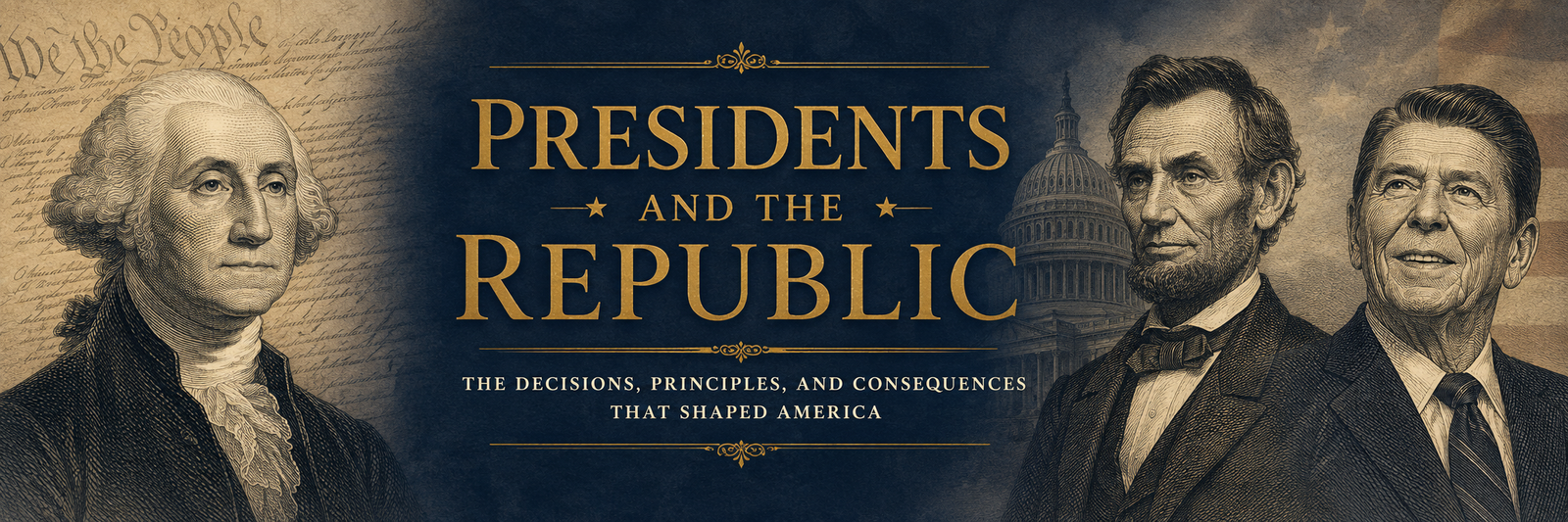
20th President • March–September 1881
James A. Garfield
A scholar, Union general, and congressional leader who rose from poverty to the presidency, Garfield entered office prepared to confront patronage and corruption—only to be shot four months later and die after an eighty-day medical ordeal.
The Road to the Presidency
From an Ohio Log Cabin to National Leadership
Garfield’s life embodied nineteenth-century social mobility through education, faith, military service, and politics.
Born in a log cabin in Orange Township, Ohio, Garfield was only eighteen months old when his father died. Raised in poverty by his mother, Eliza, he briefly worked on the Ohio and Erie Canal before pursuing an education at the Western Reserve Eclectic Institute and Williams College.
He returned to the Eclectic Institute—later Hiram College—as a teacher and then president. Garfield studied languages, mathematics, literature, and theology, preached in the Christian Church associated with the Disciples of Christ, and was admitted to the Ohio bar.
Elected to the Ohio Senate as an antislavery Republican, Garfield entered the Union Army in 1861. His success against Confederate forces at Middle Creek brought promotion, and he later served at Shiloh and Chickamauga. He became a major general before resigning to enter Congress.
Garfield served in the House of Representatives from 1863 until 1880, becoming a leading Republican authority on finance, appropriations, and constitutional questions. He supported the Reconstruction amendments, Black male suffrage, and a national commitment to public education.
The Election of 1880
The Dark-Horse Nominee
Garfield went to the Republican convention to nominate another candidate and emerged as the nominee himself.
Republicans deadlocked between former President Ulysses S. Grant, Senator James G. Blaine, and Treasury Secretary John Sherman. Garfield had delivered Sherman’s nominating speech.
Delegates searching for a compromise shifted to Garfield, nominating him despite his initial reluctance. The convention selected Chester A. Arthur, associated with the party’s Stalwart faction, for vice president.
Garfield narrowly defeated Democrat Winfield Scott Hancock in the national popular vote but secured a clearer Electoral College victory, 214–155.
Garfield took office promising equal citizenship, educational advancement, sound public finance, and reform of the federal government.
Garfield’s nomination demonstrated both the instability of the convention system and his unusual standing among rival Republican factions.
Constitution & Power
The President Versus the Patronage Machine
Garfield’s defining political struggle concerned whether senators or the president would control executive appointments.
Government jobs as rewards
Political parties commonly distributed federal jobs to loyal supporters. Office seekers crowded Washington after Garfield’s inauguration, expecting personal service to the party to bring government employment.
Conkling’s New York machine
Senator Roscoe Conkling expected influence over federal appointments in New York. Garfield challenged him by nominating reform-minded William H. Robertson as collector of the Port of New York without Conkling’s approval.
The Senate confrontation
Conkling and Senator Thomas Platt resigned, expecting the New York legislature to return them triumphantly. It did not. The Senate confirmed Robertson, strengthening presidential control over appointments.
The Star Route cases
Garfield supported an investigation into postal contractors and officials accused of inflating payments on western mail routes. Prosecutions continued under President Arthur, although convictions proved difficult to secure.
An unfinished reform presidency
Garfield did not live long enough to enact comprehensive civil-service reform. His victory over Conkling weakened senatorial control of patronage, while his assassination by a disappointed office seeker intensified public demands for change. Congress enacted the Pendleton Civil Service Reform Act under Arthur in 1883.
Civil Rights & Education
Citizenship Required More Than a Ballot
Garfield argued that emancipation and voting rights would remain insecure without education. In his inaugural address, he called widespread illiteracy a danger to republican government and urged national assistance for education.
He condemned efforts to suppress Black voting and appointed several Black Americans to prominent offices. Among them was Blanche K. Bruce, a former U.S. senator from Mississippi, whom Garfield appointed register of the Treasury.
Garfield’s record nevertheless belonged to a Republican Party whose commitment to active federal Reconstruction had diminished. His brief presidency left too little time to test whether his rhetoric would have produced durable enforcement or significant educational legislation.
The central uncertainty: Garfield clearly supported constitutional equality and Black education, but his presidency was too short to determine how aggressively he would have confronted the expanding disfranchisement and violence of the post-Reconstruction South.
Economy & Foreign Policy
A Program Interrupted
Sound money and debt reduction
Garfield supported the gold standard, stable federal credit, and continued reduction of Civil War debt. His selection of William Windom as Treasury secretary reflected those priorities.
Protection with revision
Like many Republicans, Garfield supported protective tariffs, although he also recognized that an excessively complicated tariff system encouraged favoritism and required reform.
Blaine’s larger vision
Secretary of State James G. Blaine hoped to expand American commerce and convene a conference of Western Hemisphere nations. The administration also attempted to mediate the War of the Pacific involving Chile, Peru, and Bolivia.
No completed doctrine
Because Garfield was incapacitated four months after taking office, his administration had little opportunity to establish a mature economic or foreign-policy record. Some initiatives were altered or abandoned under Arthur.
Assassination
The Shot That Became a National Medical Crisis
Garfield was wounded on July 2, 1881, but survived for eighty days as physicians struggled—and sometimes harmed him—in attempting to save his life.
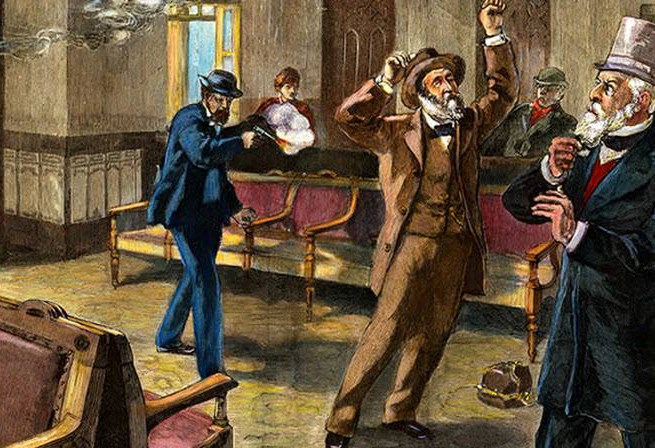
Charles J. Guiteau shot Garfield twice as the president entered the railroad station with Secretary of State Blaine. One bullet grazed Garfield’s arm; the other entered his back.
Doctors repeatedly explored the wound with fingers and instruments. Many American physicians had not fully accepted antiseptic practices, and infection spread through Garfield’s body.
Alexander Graham Bell tested an induction-balance device designed to locate the bullet, but the attempt failed to provide useful guidance.
After severe infection, weight loss, abscesses, and internal complications, Garfield died in Elberon, New Jersey. He had been president for 199 days.
Guiteau was an unstable office seeker who believed he deserved a diplomatic appointment and imagined that Garfield’s death would unite the Republican Party. He was convicted of murder and executed in 1882.
Modern historical and medical assessments generally conclude that the original bullet wound was not immediately fatal and that infection introduced or worsened during treatment contributed substantially to Garfield’s death. That conclusion should not be simplified into certainty that survival was guaranteed: abdominal gunshot wounds remained extremely dangerous in 1881.
The Constitutional Problem
Who Governed While Garfield Was Incapacitated?
For much of the summer of 1881, Garfield could not perform the ordinary duties of the presidency. Yet the Constitution then contained no workable procedure for declaring a president temporarily unable to serve.
Vice President Arthur feared that assuming presidential powers while Garfield lived would appear ambitious or disloyal. Cabinet members handled necessary administration, but major decisions were postponed. Arthur became president only after Garfield died.
The episode exposed a constitutional weakness that remained unresolved for decades. The Twenty-Fifth Amendment, ratified in 1967, eventually created procedures for temporary presidential inability and vice-presidential succession.
Faith, Family & Character
A Scholar in Public Life
Garfield’s religious formation came through the Stone-Campbell Restoration Movement and the Disciples of Christ. He preached, taught Scripture, and viewed education, moral responsibility, and citizenship as closely connected.
He married Lucretia Rudolph in 1858. Their marriage survived early emotional distance and the deaths of two children, becoming a close intellectual and personal partnership. Lucretia was recovering from malaria when Garfield was shot; she then helped direct his care and protect his papers and legacy.
Garfield was renowned for intellectual energy and wide reading. He could write Latin with one hand and Greek with the other, although the frequently repeated claim that he wrote both simultaneously is difficult to document conclusively.
Lasting Legacy
The Potential of a Presidency Cut Short
Education and Public Service
Garfield rose from poverty through study and became a teacher, college leader, Union general, lawyer, and influential legislator.
Executive Control of Appointments
His successful confrontation with Conkling challenged the assumption that senators owned federal patronage in their states.
An Unfinished Record
Only four active months in office make confident judgments about the presidency Garfield might have had necessarily speculative.
Remembered for promise as much as performance
Garfield demonstrated courage, intellectual ability, and independence from party bosses. He began confronting patronage and corruption while speaking forcefully for education and equal citizenship. But assassination prevented those commitments from becoming a complete presidential program. His death transformed civil-service reform from an elite cause into a national demand and helped prepare the way for reform under Chester A. Arthur.
Sources & Further Reading
Trace the Evidence
- James Abram Garfield: 1831–1881 — National Park Service
- James A. Garfield National Historic Site — National Park Service
- James A. Garfield Papers — Library of Congress
- James A. Garfield: Congressional Biography — U.S. House History
- James A. Garfield — Miller Center, University of Virginia
- James A. Garfield: Presidential Documents — American Presidency Project
Editorial note: Because Garfield served only 199 days and was incapacitated for much of that period, this assessment distinguishes his documented actions from speculation about the policies he might have pursued.